As a completion for a 4-H grant we received last year, we're working on creating a few guides to go along with the workshops we did. The one I'm most responsible for is titled "How to Solve Training Challenges." In the guide, we ask a series of questions. Each question-category has 5 questions to prompt the reader (be it advisor, parent, or 4-H'er) to think through the issue at hand.
We start with looking at the behavior, getting a second opinion, checking with your vet, looking at reinforcement, breaking it down, and changing approach. It's not a "do XYZ" type guide, but we're hoping it will have some use for those who are stuck.
Of course, under the "ask for help" part we're listing contact information and we're always happy to help other advisors and 4-H'ers.
I'm hoping that over the next few years we'll be able to refine the questions and end up with a very usable and useful guide.
Showing posts with label 4-H. Show all posts
Showing posts with label 4-H. Show all posts
Monday, October 24, 2011

Monday, September 19, 2011
Quick Notes on the "Drop on Recall" Exercise
I have not trained this for a million dogs. Probably only about ten. This is not a complete training guide.
Yesterday I was helping to judge a county 4-H dog show. Afterwards, I was asked questions by some of the kids and parents. One parent really wanted to know how to train the Drop On Recall.
I paused....trying to figure out what to say that could make the biggest difference. These are the few tips that I thought would be most key. Note that a majority of the dogs were trained....very differently..... than things I would recommend to begin with.
1) I will come and help. Call, email, set up a clinic. There are a LOT of steps to this behavior and for success.
2) We want the Down to be fluent, that means that the dog should lie down on just the word or signal, without the handler having to bend over, without the handler having to repeat it, the dog responds right away, and with immediacy.
3) Focus on distance, have a parent hold the dog on leash. The person is to not say or do anything but stand completely still. Kid asks for a Down. Reinforce. Kid moves a step away. Down. Reinforce. Two steps away. Down. Reinforce. Up to about twenty steps or so. Teach the dog he can lie down far from the handler.
4) When you go to reinforce the dog, always toss the treat behind or throw the toy behind the dog. This will help to discourage the dog from keeping forward.
5) Consider teaching the dog to lie on a bed. Then you can put the bed between the dog and handler. Ask for the down. Reinforce. Do a MILLION repetitions. Most people get rid of the mat before the behavior is strong enough.
I really hope I get to go do a clinic in this area. It was THE most enthusiastic group I've judged for. A TON of kids. A TON in Novice! Many kids showing in brace! (which I had to judge!). Many teams! Many kids with multiple dogs. It was really really impressive. And many of them do agility as well!
It was also interesting that while everywhere I judge 95% are not showing in buckle collars.... this was teh first time I felt I had to intervene (more than once) in the crating area when I saw things that got a bit too rough. "Hi! One of the really important things at dog shows is showing the public how we interact with animals. They want to see everyone having a good time and good human-dog interactions. It's really embarassing and hard when your dog does XYZ... How about we don't give him a chance to practice that... lets (cover the crate, let him stand instead of down stay, walk him instead of standing here in the busy area). Remember, the public is watching. And if the judge thinks you are being too rough with your dog, it could impact your sportsmanship score as well. Do you have any questions about that or how we can help your dog?"
Despite all that, I really really do like working with the kids. It's going to be a long few months until we start up again in January/February!
Yesterday I was helping to judge a county 4-H dog show. Afterwards, I was asked questions by some of the kids and parents. One parent really wanted to know how to train the Drop On Recall.
I paused....trying to figure out what to say that could make the biggest difference. These are the few tips that I thought would be most key. Note that a majority of the dogs were trained....very differently..... than things I would recommend to begin with.
1) I will come and help. Call, email, set up a clinic. There are a LOT of steps to this behavior and for success.
2) We want the Down to be fluent, that means that the dog should lie down on just the word or signal, without the handler having to bend over, without the handler having to repeat it, the dog responds right away, and with immediacy.
3) Focus on distance, have a parent hold the dog on leash. The person is to not say or do anything but stand completely still. Kid asks for a Down. Reinforce. Kid moves a step away. Down. Reinforce. Two steps away. Down. Reinforce. Up to about twenty steps or so. Teach the dog he can lie down far from the handler.
4) When you go to reinforce the dog, always toss the treat behind or throw the toy behind the dog. This will help to discourage the dog from keeping forward.
5) Consider teaching the dog to lie on a bed. Then you can put the bed between the dog and handler. Ask for the down. Reinforce. Do a MILLION repetitions. Most people get rid of the mat before the behavior is strong enough.
I really hope I get to go do a clinic in this area. It was THE most enthusiastic group I've judged for. A TON of kids. A TON in Novice! Many kids showing in brace! (which I had to judge!). Many teams! Many kids with multiple dogs. It was really really impressive. And many of them do agility as well!
It was also interesting that while everywhere I judge 95% are not showing in buckle collars.... this was teh first time I felt I had to intervene (more than once) in the crating area when I saw things that got a bit too rough. "Hi! One of the really important things at dog shows is showing the public how we interact with animals. They want to see everyone having a good time and good human-dog interactions. It's really embarassing and hard when your dog does XYZ... How about we don't give him a chance to practice that... lets (cover the crate, let him stand instead of down stay, walk him instead of standing here in the busy area). Remember, the public is watching. And if the judge thinks you are being too rough with your dog, it could impact your sportsmanship score as well. Do you have any questions about that or how we can help your dog?"
Despite all that, I really really do like working with the kids. It's going to be a long few months until we start up again in January/February!
Tuesday, August 23, 2011
More 4-H Dog Show Judging
On Saturday was my last judging assignment for this 4-H year. This event was bigger than the others, with three judges present so that all the classes could be completed efficiently.
It was very interesting that I received quite a few comments from parents and show staff, "I just wanted to say, you're so good with the kid!" And while I appreciate the reinforcement... I've been a little puzzled about it. 4-H events only have kids showing. Shouldn't "good with kids" be one of the criteria used to select judges?
We had many different breeds, some big classes, enthusiastic kids and parents, and some nice audience questions between the different class groups. Despite the high temperatures.... it was another great day!
It was very interesting that I received quite a few comments from parents and show staff, "I just wanted to say, you're so good with the kid!" And while I appreciate the reinforcement... I've been a little puzzled about it. 4-H events only have kids showing. Shouldn't "good with kids" be one of the criteria used to select judges?
We had many different breeds, some big classes, enthusiastic kids and parents, and some nice audience questions between the different class groups. Despite the high temperatures.... it was another great day!
Saturday, August 6, 2011
Local 4-H Dog Show
"My" 4-H kids showed today at our area fair. We only had four kids (one dropped early in the year, another decided not to show at fair). 1 in obedience, 3 in rally, 4 in showmanship, 3 in "dog care." Some of the judging was ... different ... than expected, but they all did well, each placed in at least one class and some of them did exceptionally well.
Most interesting, were some parent comments. Our club is strictly a positive reinforcement type training group. Most others in 4-H are not... Our parents are not used to seeing dogs get corrected and some were quite amazed/distress by the way kids were treating dogs.
And they have a point...as I said in a recent email exchange with a dog person... "It's one thing to be using punishment, even doing it properly. It's another thing to be teaching kids to use punishment and to refine their technique."
Because...when it comes down to it, most of the people teaching 4-H classes are dog enthusiasts, not dog professionals. Many are parents who were thrown into the role. Most don't have any sort of formal training or enthusiasm for continued education. They're doing what they've always been doing, and for the most part, it works well enough.
I would argue, however, that it's not necessarily what we want kids to be learning. We don't want kids to think about getting compliance through force. We do want them thinking about how to motivate others (humans, dogs, etc!). We want our kids to have empathy for their learner ("He doesn't understand, let's make it easier"), not put inappropriate labels to the actions ("He is stubborn. He knows that we're at a show and he can get away with it."). We want our kids to be good at problem solving and come up with many possible ways to get a behavior.
Not to mention we don't want the kids getting bit, escalating the force used, or being reinforced for the use of punishment ("It worked...I'll just pull on his collar next time!").
I've talked to quite a few people who don't like judging 4-H. They say it's too hard, the kids are too unprepared, that the kids don't know what to do in the ring. It's a very different event from other types of judging and for those who can remember the differences and for those that like working with kids, it can be a very good experience.
Now off to make a few notes in my file for next year....
Most interesting, were some parent comments. Our club is strictly a positive reinforcement type training group. Most others in 4-H are not... Our parents are not used to seeing dogs get corrected and some were quite amazed/distress by the way kids were treating dogs.
And they have a point...as I said in a recent email exchange with a dog person... "It's one thing to be using punishment, even doing it properly. It's another thing to be teaching kids to use punishment and to refine their technique."
Because...when it comes down to it, most of the people teaching 4-H classes are dog enthusiasts, not dog professionals. Many are parents who were thrown into the role. Most don't have any sort of formal training or enthusiasm for continued education. They're doing what they've always been doing, and for the most part, it works well enough.
I would argue, however, that it's not necessarily what we want kids to be learning. We don't want kids to think about getting compliance through force. We do want them thinking about how to motivate others (humans, dogs, etc!). We want our kids to have empathy for their learner ("He doesn't understand, let's make it easier"), not put inappropriate labels to the actions ("He is stubborn. He knows that we're at a show and he can get away with it."). We want our kids to be good at problem solving and come up with many possible ways to get a behavior.
Not to mention we don't want the kids getting bit, escalating the force used, or being reinforced for the use of punishment ("It worked...I'll just pull on his collar next time!").
I've talked to quite a few people who don't like judging 4-H. They say it's too hard, the kids are too unprepared, that the kids don't know what to do in the ring. It's a very different event from other types of judging and for those who can remember the differences and for those that like working with kids, it can be a very good experience.
Now off to make a few notes in my file for next year....
Friday, August 5, 2011
Ohio State Fair Jr Dog Show
The 2011 OSF 4-H Dog show week is now over! Agility. Showmanship. Obedience. Advanced levels of obedience. Four days of rally. Service dogs. Therapy dogs. Dog Care. Poster Contest. Skillathon. Drill Teams. Freestyle. Around 1300 entries, with many kids doing multiple events and/or showing multiple dogs.
Dozens of volunteers staying the week to judge, assist with the rings, help with scoring, and get everyone organized.
Some of the great points:
- Interacting with dog-crazy kids from all over the state
- Training discussions with other volunteers. Specifically about "good training" and the (lack of) interest in such.
- Seeing many of our campers, from this year and past years. I also saw kids from Griffin's favorite day camp and our regional workshops.
- Seeing many of "our" kids do very well.
- Talking to kids who are in their last year....they were sad but also looking forward to helping in the future
Some of the not so great points:
- Surprise! I was judging...often finding out the day-of the event.
- Seeing a lot of punishment being used....even by very young kids.
- Lots of kids not knowing the rules and loosing a ton of points because of it.
- Some of the judging/policies needing updated to make things easier/cleaner
What I'm going to try and change for next year:
- Be more prepared and ask about my jobs ahead of times.
- Continue with clinics, workshops, handouts, etc for the 4-H'ers...focusing on R+ type training.
- Work on education opportunities for the advisors/instructors to have more good R+ training.
- Increase enthusiasm for knowing the rules. Mention this at all events. Create a few games based off of knowing the rules.
- Make proposals for modifications to rules/policies.
I'm really good at complaining, but I often try to put changes along with it. If something isn't going well...we need to change something.
Dozens of volunteers staying the week to judge, assist with the rings, help with scoring, and get everyone organized.
Some of the great points:
- Interacting with dog-crazy kids from all over the state
- Training discussions with other volunteers. Specifically about "good training" and the (lack of) interest in such.
- Seeing many of our campers, from this year and past years. I also saw kids from Griffin's favorite day camp and our regional workshops.
- Seeing many of "our" kids do very well.
- Talking to kids who are in their last year....they were sad but also looking forward to helping in the future
Some of the not so great points:
- Surprise! I was judging...often finding out the day-of the event.
- Seeing a lot of punishment being used....even by very young kids.
- Lots of kids not knowing the rules and loosing a ton of points because of it.
- Some of the judging/policies needing updated to make things easier/cleaner
What I'm going to try and change for next year:
- Be more prepared and ask about my jobs ahead of times.
- Continue with clinics, workshops, handouts, etc for the 4-H'ers...focusing on R+ type training.
- Work on education opportunities for the advisors/instructors to have more good R+ training.
- Increase enthusiasm for knowing the rules. Mention this at all events. Create a few games based off of knowing the rules.
- Make proposals for modifications to rules/policies.
I'm really good at complaining, but I often try to put changes along with it. If something isn't going well...we need to change something.
Saturday, July 16, 2011
Walking Without Pulling
Last night was yet another 4-H judging opportunity. The club I work with hosted a fun match, we had about 10-15 kids attend, I did all the showmanship, obedience, and rally judging and it went a bit smoother than expected thanks to some great helpers and ring stewards.
Yet again, I saw a lot of tight leashes. It's actually becoming a hugely interesting thing. Some events last year, the kids gripped the leash right up against the collar. And they led the dog through the performance like that. I was completely unsure on how to judge that and ended up with a sort of "standard deduction" value, with any extra leash pulls (esp on the halt-sits) as additional points deducted.
Even my own club members did this! I see nice loose leashes every week! I saw pulling for the sits! Hands raised to shoulder height! Stress does very interesting things to people and dogs.
It's led me back to a talk Megan and I have had a dozen times over the last few weeks. It's hard to teach good walking. It's hard to get dogs to walk nicely without pulling, without punishment. I've spent the morning to work on reviewing my walking training plans and looking at the variations between what I do and what I have clients/students do. We'll be doing a lot of walking training tonight at the shelter and see what happens.
A few initial thoughts on the challenges:
-- By the time people get help for walking training....the dogs have been pulling for quite a while. The humans have continued walking while the dog is pulling, meaning the dog got a TON of reinforcement for the pulling ("Look, it makes the humans walk!").
-- People get into habits and patterns. They want to continue with normal walks during the training period, letting the pulling happen there, and thus compromising the training.
-- It's hard to look at the big picture, all the little times where the dog pulls on leash and the dog is allowed to continue forward. And we miss those moments. I am so guilty of that, today I counted (...after the fact each time, 8 points in our morning routine where reinforcement is distributed without me being careful to have the behavior I want before that reinforcement is delivered.)
Yet again, I saw a lot of tight leashes. It's actually becoming a hugely interesting thing. Some events last year, the kids gripped the leash right up against the collar. And they led the dog through the performance like that. I was completely unsure on how to judge that and ended up with a sort of "standard deduction" value, with any extra leash pulls (esp on the halt-sits) as additional points deducted.
Even my own club members did this! I see nice loose leashes every week! I saw pulling for the sits! Hands raised to shoulder height! Stress does very interesting things to people and dogs.
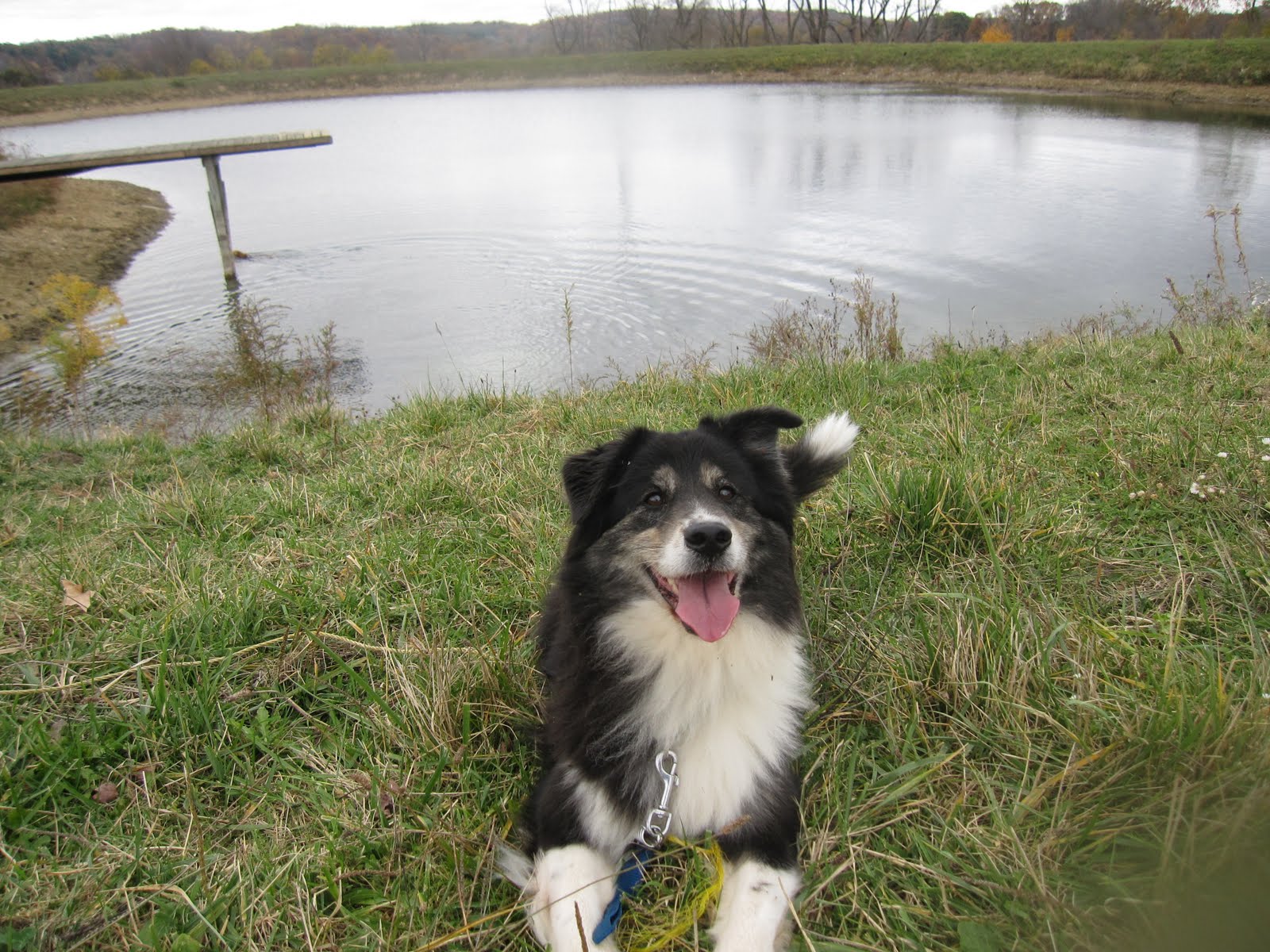 |
| Luna and Griffin both tell me that leash pulling is not a problem if you just let your dog off leash... |
A few initial thoughts on the challenges:
-- By the time people get help for walking training....the dogs have been pulling for quite a while. The humans have continued walking while the dog is pulling, meaning the dog got a TON of reinforcement for the pulling ("Look, it makes the humans walk!").
-- People get into habits and patterns. They want to continue with normal walks during the training period, letting the pulling happen there, and thus compromising the training.
-- It's hard to look at the big picture, all the little times where the dog pulls on leash and the dog is allowed to continue forward. And we miss those moments. I am so guilty of that, today I counted (...after the fact each time, 8 points in our morning routine where reinforcement is distributed without me being careful to have the behavior I want before that reinforcement is delivered.)
Friday, July 1, 2011
A Mini Lesson on Secondary Reinforcers
Tonight at 4-H practice we had a super short lesson on secondary reinforcers. As they aren't allowed to use food in the obedience ring, we need to be sure to have lots of ways to motivate and reinforce our dogs. They may typically enjoy petting or praise, but we want to work up to the dogs as excited as possible.
Primary reinforcers are the things that animals need for survival....the one we mostly utilize in training is food*.
Secondary reinforcers are anything else that can be reinforcing, often they are things we pair with primary reinforcers.
We worked on introducing a few different things as secondary reinforcers. For each one we said the word/did the action and then fed the dog five tiny treats. We repeated this 3-5 times for each one, enough so that I could see the kids were using the correct order.
 And then we did a super short session on how we incorporate these into 'real' training. For behaviors the dogs know well (sit, down, shake, etc), the order of events: Give the Cue. Dog does the Behavior. Secondary Reinforcer. Primary Reinforcer. Again, we did it enough times so that I could see that the kids had the proper order of things.
Primary reinforcers are the things that animals need for survival....the one we mostly utilize in training is food*.
Secondary reinforcers are anything else that can be reinforcing, often they are things we pair with primary reinforcers.
We worked on introducing a few different things as secondary reinforcers. For each one we said the word/did the action and then fed the dog five tiny treats. We repeated this 3-5 times for each one, enough so that I could see the kids were using the correct order.
- 1+ "magic words"
- Gently holding the collar
- 1+ types of specific petting (specific location, duration, intensity, number of pats)
- Clapping
 And then we did a super short session on how we incorporate these into 'real' training. For behaviors the dogs know well (sit, down, shake, etc), the order of events: Give the Cue. Dog does the Behavior. Secondary Reinforcer. Primary Reinforcer. Again, we did it enough times so that I could see that the kids had the proper order of things.
Wednesday, June 29, 2011
Other People Handling My Dog
In a Monday night class, we talked briefly about the benefits and risks of other people handling and cueing Griffin.
Griffin was added to my home to be my competition (obedience and agility especially!) dog.... but also my demo dog and to go out and help me help other people learn about training and dogs. Both are very important, almost equally important and possibly a bit contradictory.
Other people cuing Griffin runs the risk of Griffin learning to generalize. He might responding to cues I would not normally want to be cues. He might start giving poor behaviors or responding incorrectly. And he may be reinforced for it. This could hurt his behaviors and hurt the concepts he understands.
At the same time... I do what I can to preserve our cues and behaviors.
Griffin was added to my home to be my competition (obedience and agility especially!) dog.... but also my demo dog and to go out and help me help other people learn about training and dogs. Both are very important, almost equally important and possibly a bit contradictory.
Other people cuing Griffin runs the risk of Griffin learning to generalize. He might responding to cues I would not normally want to be cues. He might start giving poor behaviors or responding incorrectly. And he may be reinforced for it. This could hurt his behaviors and hurt the concepts he understands.
At the same time... I do what I can to preserve our cues and behaviors.
- Performance and Casual cues: I don't give away my special, "sacred," unique competition cues. I show people things that are not as important.*
- Supervision: I can specify what things we will or will not reinforce, so the new trainers are doing things correctly.
- Consistency: I am careful that when - I- train, I do not accept poor responses. Dogs can and do learn that different people have different requirements. I want to be very clear with what I expect and always expect.
- Fluency: In some ways, his response to cues given by other people show that he has behaviors with a high level of fluency. He really gets it. The behavior is proficient. I can see what parts of the cue are relevant to the behavior and which are not.
- Discrimination: At the same time, there are some behaviors and situations where I do not want him to respond to cues given by other people (competition obedience). So, I don't give away these cues. We don't work on these behaviors in the other-people-handling environment.
I also recognize the benefits of this environment for Griffin. He is learning to be even better behaved around kids. He's learning to engage with people. I am recalling him back to me on a regular basis, meaning great recall training opportunities. I can see which behaviors are strong, and which behaviors are not strong.
Last week, at the 4H Teen Camp, Luna's job was to come out during lunch. She's too shy to steal a supervised sandwich, but she would go around to the kids to solicit food. They could ask for behaviors she knows well (Sit, Down, Spin, Wave). They would reinforcer her with a piece of food. The kids were fairly stationary and sitting to eat, meaning they were not as likely to startle her compared to the usual activities. By the last day, she was more enthusiastic, working harder, and less anxious compared to earlier in the week.
 |
| Tired Luna. |
There is the benefit for the people involved. Cueing and handling a skilled dog is a very different experience than working with a less experienced dog. It can help give a good picture of the final behavior, how discrete cues can be. How to shape behaviors and add cues. In some ways, there is less risk of "messing up" the dog than with a beginner dog.
The kids we played with on Monday, learned to quietly give a cue. They learned to reinforce the behavior. They learned to start out with the exercise as easy as possible. They learned to interact with dogs and had a good time with a dog. And all of that is -so- important. And in the long run, way more important than Griffin doing his beautiful competition behaviors. That is why I'm so happy to have other people handle and train and play with my dogs.
Sunday, June 19, 2011
Camp 1
Luna, Griffin, and I got back from camp 1 yesterday afternoon. We had volunteered to do the dog activity portions and dog safety supervision at a 4-H camp that wanted to offer a "K9 Camp." The kids did a ton of the normal camp activities (boating, crafts, etc) and some training, dog health activities, and more doggy things. 
The facilities were really fabulous and quite welcoming to the dogs.
On Thursday evening, a storm passed through while we were out training in a covered shelter house. Even standing in the center we still got wet. But everyone kept working despite the distractions. When the storm slowed, we hurried the dogs back to the cabins and went to an indoor building for a very enthusiastic Training Game. Some teams progressed to cueing and stimulus control, but many kept working on shaping the behavior. We interspersed the game with some short discussions on cues and chains. Here's a list of all the pieces we could come up with for "Brushing Teeth".

It was really different. We're used to our camp where we have to do 100% of the supervision and planning. Here we had hours to ourselves where the staff were supervising and occupying the kids.
The facilities were really fabulous and quite welcoming to the dogs.
While the dog kids had to have had at least three years of dog project experience, like at the other camp we run, we did not get as experienced of a group. We modified our activities appropriately and hope that everyone had a good time and learned some new skills.
On Thursday evening, a storm passed through while we were out training in a covered shelter house. Even standing in the center we still got wet. But everyone kept working despite the distractions. When the storm slowed, we hurried the dogs back to the cabins and went to an indoor building for a very enthusiastic Training Game. Some teams progressed to cueing and stimulus control, but many kept working on shaping the behavior. We interspersed the game with some short discussions on cues and chains. Here's a list of all the pieces we could come up with for "Brushing Teeth".

We hope the camp will be able to host the event again next year and that more kids will enjoy the opportunity. Now to finish up some notes on that event and then prepare for our next camp.
Wednesday, June 15, 2011
Straight Sits
The 4H Agility Games Clinic went quite well yesterday. I had fun with the kids. We did a more beginner group in the morning and a bit more advanced group in the afternoon. We were able to stick right to schedule, and if anything, I had a bit of extra time.
 And then they demonstrated. The dog sat straight 5/5 times. The reinforcement? Came a good 10 seconds after. I demonstrated how to have the food ready and how to give several pieces, very quickly in succession, for the completion of this sit. Latency, how long it took the dog to respond, and the speed of the behavior were both lacking.
During lunch, one of the kids asked about straight sits for Obedience. Her dog has a tendency to sit crooked. Both the kid and parent spent quite a while telling me about this and how it definitely was the dog just not wanting to sit straight.
- "He's always done it." So....it's possibly been reinforced a ton from the humans. And there could be a physical cause contributing to the behavior.....something more serious like Hip Displaysia, or just the dog's general conformation making it more uncomfortable for him to sit square.
- "He especially doesn't like to sit on mulch." If you were wearing a swim suit....would you want to sit on mulch? Remember...your dog is very short haired! Sitting on cold, hot, pointy, pokey, wet things is not going to be fun.
- "In training we do heeling and then sit" It's good training to do one thing at a time. Do you want to fix your sit, or practice automatic sits in heeling, or work on heeling? If I were in your situation, I would do a lot of sit training separate from heeling, separate from stays, separate from other things....until the straight sit is fixed.
- "We're worried the judge would take off a lot of points." Not in rally, and likely not much, if any, in obedience. Watching you work, I would be more conerned about how you pull the leash every time you stop....that's 1-3* points every single time. I would be more concerned about your dog not sitting at all.... 1-3 points. I would be more concerned about your dog not being parallel with you. You have to set your own priorities.
- "He just doesn't want to do it." There area lot of reasons he might not want to....but what you're saying also tells me he thinks it is not worth it. If I asked you to reach in a big muddy gross pile to get a penny, would you do it? ("No!") If it was a thousand dollars? ("Yes!") We need to have a reinforcement history. We need to have reinforced your dog for sitting with such good reinforcement and so many times that he will sit no matter what. My dog Griffin isn't the smartest dog...he's not stupid either. But he does some silly things due to his reinforcement history. One day I asked him to put his feet up against a solid wall.....and as "up" usually means get in the car or on a bed.... he put ALL four feet on that wall....looked at me in a panic...and fell. His reinforcement history for "up" was so good, so strong, that he responded no matter what...until gravity intervened.
- "He really is stubborn." Maybe there are other contributing factors, like core strength....we can do exercise ball work or that sort of thing to build his physical ability. He is a very athletic working dog, but his types of activities, the types of terrain he works on, the things he does....may not be what he needs for the strength to do this.
-"In his previous competition training, for other sports, he was punished every time he sat." Then you're doing a great job to get sits.... we need to improve his history of reinforcement, really get things to pay off.
 And then they demonstrated. The dog sat straight 5/5 times. The reinforcement? Came a good 10 seconds after. I demonstrated how to have the food ready and how to give several pieces, very quickly in succession, for the completion of this sit. Latency, how long it took the dog to respond, and the speed of the behavior were both lacking.
 Griffin worked a bit during lunch. Outdoors, a rally course was set up. He wanted to sniff the grass at the start line. After a minute of sniffing I gave up and led him by the collar inside. He worked much better there....some bobbles due to drains on the floor and other little things....his about turns lacking. A few people sitting around clapped for his left turns and later were thinking we were crazy to not be trialing yet. They didn't see him work outside and probably think I'm too picky about my criteria. But for obedience....we really do need to "Maintain Criteria!" I was very happy with how quickly he got to work indoors....and then last night after class, he was just brilliant. I haven't gone back to watch the video....I'm afraid to see that he wasn't as great as I'd thought!
*While 4H scoring is supposed to be like AKC/UKC/etc..... it's not always....
Sunday, June 5, 2011
Gardens, Treibball, and more


These gardens are very interesting as it's a private residence that opens up once a year for the public to come in. In the past, they've only been open for two days, but this year extended it to five days with around a thousand people coming in each day.
Lots of art, bridges, water, and interesting plants. And really impressive given that they've only been working at it for twenty some years. I wish I could accomplish that much in such a short period of time!

Part way through the day, someone behind us on a trail recognized me from work...and started to tell me about how much she wanted to do Treibball. We talked about how much they had done, the online resources available and the class options.
I gave her my usual response... get a few people together and we can do a class or a few weekend workshops.
Treibball is a funny thing.... About 18-24 months ago, someone showed me a video clip from 2008. I didn't know where I had been...I had never heard of it or heard a mention. And about 4-5 months later, I started hearing about it online...and all over the place.
At Griffin's first year at camp, 2009, some of the kids taught him to do parts of it, pushing a ball into a goal, as part of a training challenge. And I know I did some early work on that when Blaze was young. Just as silly training challenges. It's always interesting to see where things go. I don't know if the interest will decline or if it will end up as a big and exciting event. We'll see.
We returned home in the early afternoon and after a few hours of misc. work, I went off to the shelter. Nothing new and exciting there (which is often a good thing). It was too hot for much training. I've been trying to pull together various video clips on how to do some of the basic behaviors we use in classes.... I got a few more parts for that and hopefully I have enough or almost enough to finish a few of these projects. It's amazing how long some of these things have been on my to-do list.
Monday, May 16, 2011
Traveling, Teaching, Training
On Saturday I did a morning training clinic at Jefferson County Fairgrounds and then a fun show for 4-H'ers in the area. Most came with slip collars, a few with head halters, all were pulling on their dogs. Our obedience sessions focused on getting movement together, seeing precise behaviors, and starting our stays. Our showmanship was on the basics of handling. The fun show had to be modified to acommodate the very beginners in their own class.
And yesterday, we went down to Warren County to do another 4-H clinic. This one was much easier (3 people teaching 10 kids instead of 1 person:10 kids), and we had a better teaching outline. The area has a very successful dog program, it was interesting to see how the kids interacted with each other and their dogs. We worked on super precise behaviors, teamwork, and breaking things down into super tiny pieces.
I took the advanced kids off to work on the retrieves... taking items (...we had to resort to "bad training" to get this...treats in a paper towel, clicking for teeth on the paper towel. One dog progressed to regular paper), sticky touches, moving towards items (dowel sticks). Griffin helped with a demo on what the next stage would be....I think I scared some of the kids and advisors with his enthusiasm....their dogs were calm and controlled and effort was made to keep the dogs that way. Griffin was literally bouncing off the walls. But he worked well. And then we talked about the lagging problem these kids were facing in the off leash heeling portions. We problem solved, came up with a few solutions, and it came down to that the kids were chattering at the dogs during heeling in training. We practiced 2-3 steps of silent heeling, then reinforcing.
I left half an hour early to help with a leash reactivity class (one dog making SUPER progress and the others progressing on great-average), flyball with Griffin (great stays, tugging, and some box turns...he had refused to last week).
And then home for dinner and sleeping.
It's great to do the traveling for the clinics and to help out all of the kids, advisors, and parents. We also learn a ton about what works (and doesn't) in dog programs. It's really quite something and a great way to gather information about how we can improve our clinics and our work with our club. It helps with programming at the state level. What I took away from this weekend: While there are state level contacts available to advisors/instructors, they don't all know it/use it. There could be a benefit to a state-available curriculum...there was one in the past but it's not currently being used/distributed. We need to start the "advanced" skills earlier on. We need more teaching and training tutorials for the higher level skills. We need more support for the advisors and instructors, especially on the kid-adult interaction portions.
The thing that really stands out about 4-H and how it's different than many/most youth programs, is that you have a variety of ages in the same group. 8-18yo kids... in some cases, younger members. And yet, you can have older kids with less experience, younger kids who are far more experienced, and your instructors and advisors need the capability to interact and teach appropriate wtih this wide age range.
Now off to prepare for our two 4 day dog camps, just a month away, and a day that I'm teaching at an animal day camp.....
Saturday, March 12, 2011
Making the Best Better
That's the 4-H motto.
And there were a ton of other really great things. One group of cloverbuds (under 8 years old) had some sort of sponsorship program...they read at the library and got little clovers on the wall representing money raised for the time reading. And then they used the money for hundreds of dollars of books to be donated to their library.
Today I was at the Ohio 4-H Volunteer Conference. About 1000 adults and about 700 kids. That's a lot of people. There were educational sessions and a big lunch-awards thing.
In the morning, as part of the state dog committee, I helped with a presentation on the dog program this year. I got to talk about our camp, how to teach CPE games, and a little about teaching rally.
Our club advisor had nominated our camp crew for the Innovator Award. And we were one of three groups to receive the award. We have a big fancy plaque to ....hang on the wall when at camp?
But it was amazing to hear about all of the great things people are doing. One of the other innovator receivers had created a day long cattle camp. Another was a kid who heard her county would be shutting down 4-H due to lack of funding...so she raised THOUSANDS of dollars to keep it running.
And there were a ton of other really great things. One group of cloverbuds (under 8 years old) had some sort of sponsorship program...they read at the library and got little clovers on the wall representing money raised for the time reading. And then they used the money for hundreds of dollars of books to be donated to their library.
There were also special awards for adults who had been volunteering with 4-H for a really long time. One of them had been a volunteer for seventy years. To be dedicated to the same program, for THAT long, impacting THAT many kids. Wow!
Then, on the other hand, this is my fifth year as a volunteer and in some ways it seems like forever, and in other ways, not enough time at all.
So... we'll keep playing with our 4-H curriculum. We'll keep working on our new projects. We'll keep changing what we're doing with the dogs. Well keep making the best better.
Friday, March 11, 2011
4-H Training in 2011

Last week we had our first 2011 practice with our club. We had 6 members attend (out of, I think 8?) and had a fabulous time.
Typically on the first night, with not having worked the dogs in this environment (if at all) since early August, the dogs are a bit wild. But all were great, 2 are only on their second year of 4-H. And the dogs were amazing.
With our beginners last year, we focused on showmanship. They all did an amazing job. This year, we'll continue on that (in the B classes, they'll have to be even more skilled!), as well as continue to prepare them for rally, and hopefully obedience. I'm also hoping more of our kids will participate in the state fair.
We spend our first half hour working on obedience type skills, second half hour on handling (without the dogs for obed, rally, showmanship) and knowledge, and the third half hour on our showmanship and tricks/agility foundations.
Tonight will be our second practice, I'm really looking forward to seeing the kids and dogs again!
Monday, February 7, 2011
Judging Clinic

We went to the 4-H Judging Clinic on Saturday, it was fun to see a lot of people from all over. One of the more exciting was someone I had seen at ClickerExpo last March....she has a fabulous golden and they do obedience. I saw her at a few 4-H events, and finally caught up with her last August. She's given me a name of an obedience instructor that I'll probably be doing some privates with.
Last year was my first time judging with 4-H. Our club did two fun shows (I did the showmanship judging) and I got to judge Obedience, Showmanship, and Rally at a county fair.
During the clinic I learned a lot about what I could be doing better, but I also learned about all the things I was doing well. I disagreed with the presenters at times, but that's the great thing about judging.... unless it's in the rules, it really is up to the judge.
I learned about some new systems for scoring, like flipping up your paper and using the opposite side for making notes about the patterns and noting crookedness, lagging, forging, etc. This will provide more info for the exhibitor and help me keep on track.
I learned how important it is to read and know the rules. It appeared that others did not.
I really like how we do discussions at the end of our fun shows. We talk about what we saw, what the kids really need to work on, what judges are looking for, how things will be the same or different at other fun shows, at county fair, and at state fair.
I learned how to better prepare our kids for events. Some of the things I'm teaching because it's how things are done. Some of the thigns I do because of the project books listing xyz as being important. But some of the things we do are superstitious. I thought I had gotten rid of most of those...but some are still present (too much eye contact to the judges).
Ultimately they had enough demo dogs for the time frame, so Griffin didn't need to work. That may or may not have been a good thing. But he was adorable when he came in for a visit later.
I realized later I should have gotten some of my doggy friends to go, that they could be very good judges. I also wished that the instruction at the clinic had a piece on teaching and how to appropriately interact with youth.
Subscribe to:
Posts (Atom)