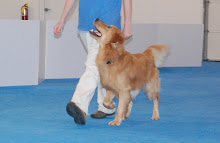
Griffin doesn't appreciate grooming/vet type handling. He has always been cautious about handling and it got a lot worse preceding Lyme disease being diagnosed. Those exams were very painful and uncomfortable for him.
Here's a quick video showing how happy he is about eye drops. We've done the training steps a few times before, but even the first time it was very similar to in this video. He has such a great "sticky target" and he's learned to stay touching while I brush, pet, and poke at him that the eye drops were just another part of the activity.
He is always allowed to move away, but he doesn't usually choose that option. He wants to keep working and to get more treats.
For a dog who doesn't have a good sticky touch already trained, I would do similar steps with holding the dog under the muzzle (gently and always letting him pull away if needed).
A few years ago, we had a puppy at the shelter who went blind just a few days after arriving. It ended up being some unusual medical condition and she needed twice-daily eye drops. She couldn't see the volunteers approaching or know what was going to happen so it was always a surprise to be grabbed and then have "horrible" things done to her. Especially as she was already a puppy, she got extremely mouthy and many of the volunteers did not like to handle her or they were scared of her. With a few training sessions and with warming up the eye drops by putting them in a pocket (they were stored by a window, in the winter they got cold and made her even more upset), she was much improved. The shelter raised funds, she had surgery and was able to see again, and was eventually adopted by a veterinary student. Last I heard, she was going on long drives between family here and the university far away. She was hiking and exploring and going to dog parks and a really great dog despite being a naughty puppy.
Showing posts with label Training. Show all posts
Showing posts with label Training. Show all posts
Tuesday, February 14, 2012

Monday, January 30, 2012
The cost of selecting the wrong dog trainer
I see a lot of dogs. People typically want the best for their dogs, but they're not always in a position to know what "best" may be. They aren't the professionals in the situation and their perspective is very different than that of someone in an 'expert' role.
At the best end of things, the person just adopted the dog or had only done a few basic classes by the time they're directed to a vet behaviorist. After the appointment, (and often meds), the dog is able to learn better, do better, and actually progress in class and at home. The downside is the time, money, and frustration that the family unnecessarily experienced up to that point.
At the worst end of things, the family only does a consult after a lot of training or trainer shopping and after the dog has experienced some pretty horrible things at the hands of people who are often not all that skilled with various ...interesting....punishment strategies (whether intentional or not). The human-animal bond is often damaged. And it takes a lot more time, training, and effort to get everyone to start progressing.
And sometimes the cost is higher. By the time the family is seeking more help, the family may not have the patience, time, or money to actually work with the right professional and follow through with treatment. The family might feel like training won't work because the five other trainers resulted in no real success.
The dog may go untreated for months, years, or life. The dog may be regulated to excessive crating or kenneled in the backyard. People, animals, or family members may be physically injured. The dog may be adopted out or euthanized. The family isn't going to feel so great about dogs for a really long time.
This is why problem areas need to be addressed right away. Families need to know how to seek help, and where to seek help. Beginning and less experienced trainers need to know when to refer. Beginner/basic classes and puppy classes should be taught by the most experienced people possible, not those just learning (they should assist and learn!). If problems are noted, the family needs to be pointed to the right help, right away. Trainers need to attend/participate in continued education events so they're better able to help people. Vets need to ask leading questions to identify problem areas ("How is he left home? How is house training? Storms and fireworks? Are you seeing any training problem areas?").
It's not easy.
And some real numbers with Blaze:
Puppy class. And a second, third, fourth class. Five or six sport classes. A lot of books. A few privates. Extra health tests. And then to the vet behaviorist (4.5 hours away!). Neurologist appointments. So, after only about $1800ish of training (not counting the very $$ obstruction surgeries that didn't heal well even though the pica is probably related to his behavior challenges) we had our $300ish appointment. He was diagnosed and we received treatment options.

Blaze was labeled as a "Just needs more training." puppy.
If we had gotten the right help from puppy class, it would have saved a lot of time, money, energy frustration. He would probably be a different dog than he is now, though not 'normal'. We would have saved a lot of money, or at least gotten more for our money rather than many classes where he didn't progress and instructors berated us for not practicing. I have family members, adults, who are afraid of Blaze. He's not an aggressive dog, just bigger and lacking self control. Their relationship with him and all dogs has been damaged.

At the best end of things, the person just adopted the dog or had only done a few basic classes by the time they're directed to a vet behaviorist. After the appointment, (and often meds), the dog is able to learn better, do better, and actually progress in class and at home. The downside is the time, money, and frustration that the family unnecessarily experienced up to that point.
At the worst end of things, the family only does a consult after a lot of training or trainer shopping and after the dog has experienced some pretty horrible things at the hands of people who are often not all that skilled with various ...interesting....punishment strategies (whether intentional or not). The human-animal bond is often damaged. And it takes a lot more time, training, and effort to get everyone to start progressing.
 |
| As a puppy, Luna was anxious, lacking confidence, had housetraining problems, and no trainers addressed these concerns. |
And sometimes the cost is higher. By the time the family is seeking more help, the family may not have the patience, time, or money to actually work with the right professional and follow through with treatment. The family might feel like training won't work because the five other trainers resulted in no real success.
The dog may go untreated for months, years, or life. The dog may be regulated to excessive crating or kenneled in the backyard. People, animals, or family members may be physically injured. The dog may be adopted out or euthanized. The family isn't going to feel so great about dogs for a really long time.
This is why problem areas need to be addressed right away. Families need to know how to seek help, and where to seek help. Beginning and less experienced trainers need to know when to refer. Beginner/basic classes and puppy classes should be taught by the most experienced people possible, not those just learning (they should assist and learn!). If problems are noted, the family needs to be pointed to the right help, right away. Trainers need to attend/participate in continued education events so they're better able to help people. Vets need to ask leading questions to identify problem areas ("How is he left home? How is house training? Storms and fireworks? Are you seeing any training problem areas?").
It's not easy.
And some real numbers with Blaze:
Puppy class. And a second, third, fourth class. Five or six sport classes. A lot of books. A few privates. Extra health tests. And then to the vet behaviorist (4.5 hours away!). Neurologist appointments. So, after only about $1800ish of training (not counting the very $$ obstruction surgeries that didn't heal well even though the pica is probably related to his behavior challenges) we had our $300ish appointment. He was diagnosed and we received treatment options.

Blaze was labeled as a "Just needs more training." puppy.
If we had gotten the right help from puppy class, it would have saved a lot of time, money, energy frustration. He would probably be a different dog than he is now, though not 'normal'. We would have saved a lot of money, or at least gotten more for our money rather than many classes where he didn't progress and instructors berated us for not practicing. I have family members, adults, who are afraid of Blaze. He's not an aggressive dog, just bigger and lacking self control. Their relationship with him and all dogs has been damaged.

Friday, December 30, 2011
Griffin: Attitude and Arousal
Griffin and I are having a great time in our online obedience class. It's one of the best things I've ever done. I'm learning so much and we're being challenged in many ways.
But with the class has come a horrible realization that I've made some huge, huge mistakes with Griffin.

In many sports and activities there's a bit of discussion about arousal and performance. If you're really relaxed, you won't do well at most sports. If you're too worked up, you also aren't going to do so well. The optimum arousal will depend on the activity...obviously the optimum arousal for chess is different than that for speed skating.
I've made an effort to make enthusiasm and attitude part of Griffin's training. If he's not being excitable enough, we don't do heeling or retrieves. I don't want poor responses being reinforced, ever.
If you train low latency (time from the cue to when the dog responds) for a few behaviors, it's often generalized for everything. The same sort of thing seems to have happened. Griffin is quite excited and enthusiastic about training.
This is great for some behaviors, but not too great for others. I've intentionally-but-shouldn't-have trained him to be a bit --too-- excitable for many behaviors and this is (likely) contributing to the slow progress of stay duration.
Over the last 18 months we've worked really hard to increase the number of reinforcers we have available as well as to increase the value of the reinforcers. This is adding arousal to the behaviors. His attitude to training is continueing to improve.
Another challenge area was that I compared Griffin to the diagnosed-as-hyperactive Blaze. And in comparison, Griffin -is- calmer. But that doesn't make him calm.
Now to develop more ways to intentionally decrease arousal and excitement. We have to create a lot more calmness.
 |
| Exhaustion is not the same as calmness. After 4 days of camp, Griffin was so tired he would not move. |
Wednesday, December 28, 2011
"Not Good Enough"
One of the things that many dog teams will say, especially those working on competition training or behavior modification, is "I just think he would do so much better if you were training him."
And the thing is, most dogs would do better with a trainer handling them. It's not that there's anything magical about most dog trainers (though there are a few I wonder about....). Most of these people have spent a lot of time training dogs, which means more practice, better decision making, better timing, better able to adjust criteria, and being able to evaluate the situation**.
That said, it's important to recognize that most trainers probably think the same thing at various points.
What would Blaze and Luna be like if they were in a home where they got appropriate help as puppies? Several trainers I admire talk about their challenging dogs and being able to overcome the challenges. I've had to accept that it just won't happen with Blaze. With Luna, who knows what progress is available, we're battling the lack of early socialization and bad luck with genetics. And while Griffin is a very normal and adorable dog.... he has siblings competing at the highest levels and yet we've had to twice walk out of the rally ring after less than half the course. It's definitely all me holding him back.
I know Griffin would do better with many of my students. He would benefit from long walks in town every day, from a busier household, with more time and attention and regular attendance in class. Hours and hours in the woods. A classroom full of kids every day. He would do well with someone who is a perfectionist. And I can't give him all of those things right now.
So what do I do?
- I make training plans for my dogs to address the biggest issue areas. I try to be productive with our time. We try to maximize the benefits of any choices we make on how to spend our time.
- I try to improve my skills. I spend time training my dogs and any others (....one of the reasons I volunteer at the shelter!). With good practice, I should get better.
- My class/lesson students are also part of this. This allows me to see things that work and don't work as well with hundreds and hundreds of dogs. There's no way I could learn so much with just working with my own dogs.
- I learn more and try new things. Seminars, books, DVDs, online articles and resources. Training groups and classes. There is just so much information available now.
- Learn from the best: In whatever area we're looking at. We use whatever materials we can get ahold of. We use what we can, make modifications of others, and try to evaluate and work to maximize our success.
And how is that working? I'm continually making refinements to our training plans. I'm getting better. The learning curve is not as steep as it was a few years ago. But if a small change cuts off minutes or hours of training, all the better.
**Massive amounts of practice or dedication are not, alone, sufficient. The practice time has to be "good practice." Spending many training hours of late clicking will only let someone get more proficient at late clicking. Some people are able to self-evaluate. Others need class and learning opportunities to become more proficient.
And the thing is, most dogs would do better with a trainer handling them. It's not that there's anything magical about most dog trainers (though there are a few I wonder about....). Most of these people have spent a lot of time training dogs, which means more practice, better decision making, better timing, better able to adjust criteria, and being able to evaluate the situation**.
That said, it's important to recognize that most trainers probably think the same thing at various points.
What would Blaze and Luna be like if they were in a home where they got appropriate help as puppies? Several trainers I admire talk about their challenging dogs and being able to overcome the challenges. I've had to accept that it just won't happen with Blaze. With Luna, who knows what progress is available, we're battling the lack of early socialization and bad luck with genetics. And while Griffin is a very normal and adorable dog.... he has siblings competing at the highest levels and yet we've had to twice walk out of the rally ring after less than half the course. It's definitely all me holding him back.
I know Griffin would do better with many of my students. He would benefit from long walks in town every day, from a busier household, with more time and attention and regular attendance in class. Hours and hours in the woods. A classroom full of kids every day. He would do well with someone who is a perfectionist. And I can't give him all of those things right now.
So what do I do?
- I make training plans for my dogs to address the biggest issue areas. I try to be productive with our time. We try to maximize the benefits of any choices we make on how to spend our time.
- I try to improve my skills. I spend time training my dogs and any others (....one of the reasons I volunteer at the shelter!). With good practice, I should get better.
- My class/lesson students are also part of this. This allows me to see things that work and don't work as well with hundreds and hundreds of dogs. There's no way I could learn so much with just working with my own dogs.
- I learn more and try new things. Seminars, books, DVDs, online articles and resources. Training groups and classes. There is just so much information available now.
- Learn from the best: In whatever area we're looking at. We use whatever materials we can get ahold of. We use what we can, make modifications of others, and try to evaluate and work to maximize our success.
And how is that working? I'm continually making refinements to our training plans. I'm getting better. The learning curve is not as steep as it was a few years ago. But if a small change cuts off minutes or hours of training, all the better.
 |
| Photo by Terri Tepper, 2008 |
Sunday, December 18, 2011
Non-Anthropomorphic
I'm probably too careful to not use any human-type words or traits and I know it's annoyed more than a few people who spend a lot of time with me.
One I hear most is about "stubborn" dogs.
Lots of students tell me about how their dogs are stubborn. Many times, it's used to justify the use of punishment. With some people I help them by joking our way through the situation.
"My dog is so stubborn! She won't walk with me!" Me: "Does she enjoy staring at squirrels? How much fun has she had chasing/staring at squirrels? How much fun has she had for walking nicely? Remember....we've only been working one week. If you were a dog and given a choice, what would you probably do? Would that make you stubborn...no, she's just doing what is more fun."
The other part....stubborn seems to imply that the dog is making a choice to specifically annoy the humans, or at the very least, the dog is intentionally resisting the training process. This means the dog has to understand right-wrong. The dog knows what will "annoy" the person. The dog is intentionally avoiding the reinforcers/"taking" the punishment to further annoy the person. That's a really complex situation.....
So what's going on? I try to get the dog's family to look at what is going on.
- We may be reinforcing the wrong behavior (Incorrectly done "Look at That")
- We may not have strong enough reinforcement history for the situation (above example of dog and squirrels).
- The dog may just not understand the behavior.
- The interaction may be punishing to the dog...so despite reinforcement being offered, the way the reinforcer is delivered or something about the environment is making the dog really want to do something else (Think, a scared dog and the teeter).
 |
| In this situation, Griffin will often refuse food. Even raw hamburger. He is too excited about the environment to be interested in food. He is not making a choice to leave the food. He is not intentionally try to get out of training. |
What tends to help the most, is getting the people to develop some empathy for the dog and understanding of his situations. The most damaging part of some labels, like "stubborn" is that it puts the people against the dog and it's too easy for the humans to take the situation personally. Once we're able to step back and in Karen Pryor's words, see it as "just behavior," the training and interactions go better. Teamwork rather than putting the dog an person against each other.
Monday, November 14, 2011
Additional Benefits of Training
Griffin's relatives are very, very busy and it's been an overall very successful year for "the family." High level accomplishments in agility, obedience, field work, and tracking.
In an email his breeder sent out this week, she talked a little about the "richness" that the dog sports and training and activities add to our dog's lives, as well as to the people involved.
There's the change in behavior that can be useful/practical for daily use, but there's also the physical and mental activity, giving the dogs a chance to do doggy-things, to go places and do things (off property experiences can be helpful for preventing some types of behavior problems!), and more.
With my experience, it's really been a very different relationship between myself and the first dogs I knew and my dogs now. Through training and those types of interactions, it's created a very different relationship.
 And even on the short term, there have been a few dogs at the shelter that have a -very- different relationship with me after training. Previously, people were for feeding and opening doors and anything else involving thumbs. Now these dogs are soliciting interaction and demanding to something with people.
Here's one of the dogs a few days ago. If I'm working another dog nearby, she stands with her nose pressed through the fence, getting as close as she can, hoping I'll do something. Occasionally she offers a sit or a down or a bark. She used to just go off and do her own thing, ignoring people.
Saturday, October 29, 2011
Asking the dog to work, compared to the dog asking to work.
Most dogs can fairly quickly to get to this point in class.
For the other team, the person had a ton of stress over the week and really just wasn't caring about the training. While the other things in the life of the family were unfortunate, it did take away some of the focus from the dog's behavior and misbehavior. I didn't have to mediate the unspoken 'battle' to 'win'. They just worked. If we had a poor response, we easily and completely changed criteria and soon were back. It was easier for me. Easier for the human. Easier for the dog.
At the shelter there is a 8+ year old not-very-mobile beagle who always begs to work. She stares right at people and offers her behavior and offers stillness, trying to get any chance to work. She used to be very non responsive, but with her love of food and a few minutes each week, she has become very demanding!
For some teams, it takes longer to get to the dog demanding work. The first things we look at are making sure the dog is comfortable (worried dogs have enough to think about other than work) and making sure the reinforcers are actually reinforcing.
Some handlers try harder and harder to 'make' the dog work and respond and even without using obvious and intentional punishment, the dogs can find the interaction unappealing. And if the interaction is stressful...they have no reason to stick around. The dog is more unresponsive and the handler tries harder and it's a really difficult cycle for everyone. It's understandably easy for the handler to think about the dog as "intentionally" not responding and to start finding ways to justify the use of punishment. Daily life and interactions become a battle that the person wants to 'win'.
Many of these dogs are quickly unresponsive to luring. The handlers keep trying because at some point the dog responds, the handler sees the behavior happen, and then the handler is reinforced. But it's a very different picture than a dog that is immediately and always following a food lure.
This week we saw success after long periods for two of these teams. For one, I was able to get the owner to only be tossing reinforcers and not hand feed. This changed the picture, decreased social pressure, and let us go for approximations. We were able to think about only getting what would be ideal and not asking for too much. Just because the dog would do a million behaviors with luring and prompting didn't mean those behaviors were our competition ideal behaviors.
For the other team, the person had a ton of stress over the week and really just wasn't caring about the training. While the other things in the life of the family were unfortunate, it did take away some of the focus from the dog's behavior and misbehavior. I didn't have to mediate the unspoken 'battle' to 'win'. They just worked. If we had a poor response, we easily and completely changed criteria and soon were back. It was easier for me. Easier for the human. Easier for the dog.
---
Until students feel the difference of the dog begging to work, it can be hard to understand the difference or even feel it. My dogs sometimes overwhelm other people who are not used to the difference. Once when Griffin was around 7-8 months old, I had a student handle him in a practice rally course to compare the difference between her dog who was lured through and not as responsive. She enjoyed the experience but attributed to his breed and personality. While those factors are important, it's not the only thing that gets a dog asking to work.
At the shelter there is a 8+ year old not-very-mobile beagle who always begs to work. She stares right at people and offers her behavior and offers stillness, trying to get any chance to work. She used to be very non responsive, but with her love of food and a few minutes each week, she has become very demanding!
Thursday, September 29, 2011
Luna Notes
More than one person has lodged (logged?) an official complaint that I do not say enough about Luna.


There is not very much to say about Luna. We take walks. She wrestles and chases Griffin. She sleeps. Sometimes she does training. On occasion we go somewhere.
It's been a very long time since we had our weekly(+) agility classes, occasional agility trials, camping trips, and other adventures.
We intend for that to change! In a few weeks Luna will (hopefully) be in a class designed for dogs to learn to be calm and controlled and wild and controlled around other dogs. There will be some obstacle/object interaction, some playing, and good training.
I'm hoping we can get back into agility trials by the spring...it may be wishful thinking, but we'll see what we can do.
Before our class that starts soon...we have work to do.
1) Car rides: Luna hates the car. Meals and super great treats in or near the car. Jumping in and out of the car. Time in the car with Griffin. Short car rides.
2) Crating: I will probably be teaching a class before/after her class. Luna will have to be crated in the training building. I've made some bad choices and the only times she has been crated in the last year has been for camp and maybe one day at the training center. It wasn't because she's comfortable without the crate...it was lazyness and not working on her crate-dislike issues. We'll practice going in the crate, eating in the crate, and spending time in a crate. I'll take her to the training center a few times before class starts and have her crated near Griffin.
3) Off Property Walks: I'm not able to handle the recommended twice a day 20 minute off-property walks. We'll try to get out 3-4 times every week. Either a different part of the property or a trip into town to walk.
4) Tricks and behaviors: Increase the reinforcement history for a few tricks/behaviors so that we have things we can do in class.
5) Find some great foods: Be sure she is on a good eating schedule, that we have high value reinforcers, and that I will have reinforcer options when we get back to class.
6) Visit the Building: We're lucky and the class is someplace I visit many times per week. If I take her when I work, she can have some time training and playing in the building after classes. I did this a few times early in the year, but she was often very skittish and easily startled unless Griffin was out with her. I think she'll do better in a class setting than in an empty room. Short visits and play times should still help prepare us for class.

What do I expect? Luna will be stressed and not happy, tail tucked, inattentive. After 5-15 minutes, she will probably get more attentive and work better except for moments when people are nearby and she gets scared. She won't eat well during that first part of the class, but then will eat more readily. Once she is comfortable, she will do her behaviors. I also expect that each week she will get to her comfortable point much faster.
I'm hoping that if we're in the building earlier in the day for training I can let her run around with Griffin. She's much more confident with him nearby. I wish I had a second person who could handle him so they could be together in class, or at least for the first day or two. I'll just have to prepare and take great treats!
Wednesday, August 24, 2011
One Piece At a Time
It's so easy to end up working on multiple things at once. It's hard to set criteria and stick to it. Here are a few examples from this week:
1. Sit AND Take Treats Gently: I saw this more than once. Dog owners want the behavior and the dog to be gently taking the treat. If the dog is jumping up or rough, they pull the treat back and then slowly lower it while saying "eaaasy." Yes, if we give a dog a treat when he's taking it roughly we reinforce the roughness.... that said, we can't be working on our sits, downs, etc AND taking treats gently.
So? We stop and work on taking treats gently. We talk about placing the treat into the dog's mouth, rather than letting him come up to take it. We talk about how to hold the treats. We talk about other options, like tossing, dropping, putting it in a bowl, or holding the treat in a flat hand ("like feeding a horse").
Then we can go back to our sit/down/etc training....and use the "alternative feeding methods" of dropping, tossing, placing on the floor, so that the dog cannot practice improper treat taking AND we can work on the behavior/s we need.
2. Come AND Sit: Another one we see often. Dog runs to the owner! Horray, past the distractions! And then the dog is asked to Sit. The dog gets distracted at that point or doesn't comply and wanders off. Not only do we have a that sit problem.... but we didn't reinforce the brilliant recall.
We work on the running to the owner part of the recall, without an end behavior. We do consider that by placing the treats right at the human's heels or between his/her feet, the dog is extra close.
Separately, we repair the Sit and teach the dog to auto sit in front of the human. Toss a treat away. Your dog eats it and comes back. Ask for a Sit. Dog sits. You toss the treat away. Dog eats it...comes back...repeat. Soon the dog is automatically sitting on the return. Only after lots of practice in many places do we put it all together.
Dog comes. Gets a treat. Sit. Gets a treat. And we start the repetition over. When all has gone well...we start to feed less on the come and still maintain the treat for the sit.
3. Stand AND Stay AND New Reinforcer AND New Handler: This one is all my doing. Today at training, some of the others had a Really Great Idea for training Griffin's stand stay. I wasn't all for it, but it probably wouldn't hurt either. I decided to let them try it.... that way if it was a disaster, the errors would at least be associated with someone else, rather than me.
His current favorite reinforcer is "Friend with a treat bowl, running away". We've used this some on his scent work, but especially for his Drop on Recall and some heeling. The person is behind Griffin a ways. He does the behavior. I mark and send him to the person....the person runs off. Griffin catches up and is fed little treat bits until I come and drag the unwilling dog away from his best friend. He loves this because it's "Friend+Food+Chase+Lots of Food Pieces".
During his Stand training...he had a new handler, his high level food person reinforcer-thing, and it just didn't go well. He actually wouldn't even stand for the new handler. He was SO excited and worked up that he would sit and down and bounce and bark. I laughed. We quickly gave up on that.
If we were to do it...I would handle him with his running person. I would have his new handler work on quiet/less exciting reinforcers. And then we would put it all together.
Griffin was -so- happy. He's adorable when he works and his enthusiasm is very amusing. Part of it is him, part of it is that he's a golden, and part of it is our criteria for enthusiasm.
That said...we only train one part at a time... enthusiasm is one of our primary pieces.... speed. Precision is much later. That's another story.
Thursday, August 18, 2011
Pieces of a Good Recall
1) Dog turns away from something potentially interesting. This could be a smell, a sound, something still, ,something moving, an animal, or something very edible. Your dog could be moving or still when you call.

2) Dog runs to you at full speed. A fast moving dog is less likely to be distracted on the way back and he will have a straighter line.
3) Dog is close enough for you to hold. A dog that stops further away.... is not very helpful in most contexts.
4) You can hold the collar. This is especially important for emergency situation.
Just like with anything else, we train one part at a time. We have exercises for each piece. Once the pieces are separately trained, we can put the behavior chain together and run through the complete exercise.

Sunday, July 31, 2011
When A Training Session Doesn't Go Well
Last night we got to the park before teaching a lesson. I took out Griffin. He lined up to heel. I gave him some cream cheese. And he turned away. I offered it to him immediately, he still refused. We tried canned food.
I worked to get him tugging. Once I'm sure that it's a reinforcer...we can go back to training. But it wasn't going to be a reinforcer.
After the lesson, we tried again and he still wasn't interested. So we went home.
Not very much happened but...as always I added some things to my "To Train" list.
I worked to get him tugging. Once I'm sure that it's a reinforcer...we can go back to training. But it wasn't going to be a reinforcer.
After the lesson, we tried again and he still wasn't interested. So we went home.
Not very much happened but...as always I added some things to my "To Train" list.
- Fix his -go-to-the-bathroom cue. I think part of the problem was that he needed to....but was too distracted.
- Get him comfortable eliminating (quickly!) in various locations.
- Continue to increase the value of varied food and toy reinforcers.
- Do more sessions of getting out of the car to work for 1-2 min, back in to go to another location (usually a block away).
The work he did was actually quite nice. I was nervous about not having a way to reinforce the behaviors. There is ALWAYS something happening... the behavior growing stronger or the behavior getting weaker. And I don't want my behaviors to get weaker!
Thursday, July 28, 2011
Conflict regarding Greeting People

We talked about this at training yesterday and it's been a constant source of....conflict... for me.
How should young and enthusiastic dogs be greeting people? If the dog is super enthusiastic and frenzied....is it ultimately best for them to be meeting and socializing? Will enough of that calm them down...eventually? Or do we want them to be primarily in work mode?
From when Griffin was 10-18 months (or so)...we tried different ways to get him greeting appropriately. Sit for treats from strangers. Strangers being still if he jumped. People leaving if he jumped. People walking closer if he was sitting. He got more and more and more frenzied.
Since then... for the most part, he's not allowed to socialize with people. If we're in public we stay far enough away that no one will ask or we are so focused that people are not likely to ask. If they do? We're in a hurry, maybe next time. I'm not willing to bet $100 Griffin will greet calmly and I don't want to compromise his training. I also don't want him to be very distressed about the greeting.
When we do camp and events.... he is great being pet by the kids. Because he is working. He's watching me, or getting a pet and turning back. If one kid came over...he did try to jump up and be all over the kid.... but if there were many and the kids were training him or if I was right there? Work mode.
Greeting people just isn't something we allow happen (same for greeting dogs when on leash). If greeting people happens, we try for it to be completely work, serious, focus on me... (or we try. There are moments where I misjudge!).
We are seeing measurable progress. He's much improved since we took away the greeting. The thought that he might get to greet had been taking over his head.....and that potential exciting event was just too much. But now he knows exactly what will happen and the interactions are less stressful for him, me, and the people.
Tuesday, July 26, 2011
Exercises to Keep Dogs off of Counters and Tables
We go over this almost every other week. Usually with young dogs who just discovered the joys of the countertops. We recently had a dog in class who had been exploring and successfully finding snacks on counters for over four years. The family had the dog wear a bell so that they had a better chance of stopping her. Five weeks later? The owner reported the dog was massively improved, people who didn't know the dog had more training were super impressed by the changes.
Management:
1) Prevention. The counters are kept cleared off. Obviously, anything the dog eats or plays with can be reinforcing. The feet up and exploration can also be reinforcing. For the life of the dog you should have clean counter habits. All it takes one mistake and your dog could eat something incredibly dangerous. It's not worth that risk.
2) Gates and crates: Dog is kept out of the room except for training scenarios until the training process is completed.
3) Dog on leash/crated during meals: Not giving your dog a chance to make those errors. Management is key.

Training:
1) Practice stays in that room: One person preparing meals while the other is reinforcing the dog for down stays. Feeding as often as needed. This can be done with one person... go open a cupboard, go back and reinforce. Pull out a cup...go back and reinforce. Put water in the cup. go back and reinforce. Most people push the dog too far. We want to reinforce very often, so we have a very strong reinforcement history. A go to bed/mat can help clarify the staying aspect here.
2) Leave it: Automatic and on cue. Step one of this is a treat in a closed fist...wait for dog to back up...then click and give a yummy treat. Repeat a lot until the dog is offering leaving things alone. There are a lot more steps to this...but it deserves it's own post. We do NOT want to be verbally cueing leave it. Most of the counter scenarios...you don't need this with the counters, you want the dog leaving the cake by himself.
3) Squirrel Game: Again, a longer exercise, but essentially walking back and forth past a distraction at a distance where you know the dog can succeed. Feeding often. We want to be working hard enough that your dog is slightly challenged....so feed often, reinforce those behaviors.
If you mess up:
And see your dog jumping up...calmly leave the room or quietly and causally move to your dog. You do NOT want to yell or move suddenly or physically stop your dog. Dogs VERY quickly learn to ONLY take things if you are not present. This is ---incredibly--- dangerous because then you don't know what your dog has taken. And it makes training very difficult.
Saturday, July 23, 2011
Training Time Responses Compared to "Real Life" Responses
This week I had multiple students tell me that their dogs are great in training but not in "real life." It's actually not something that comes up too often, usually the dogs are better in "Real Life" than I would have expected. At the same time it is a complaint that I often hear online.... "My dog is good at class but doesn't listen at home," or "He only listens if I have a treat."
In response, I have these questions:
*Somehow I haven't ever shared this game....it will be added to the "to do" list. I used to use it all the time...but have not in recent years. Dump all your treats and toys onto a table, just like at airport security. Lead your dog away a bit, ask for a behavior, run to get a treat/toy. Go away again, ask for something. Return to get a reinforcer. The dog is learning to work even if the reinforcers are not immediately present. The person is learning how to teach the dog to work when reinforcers are not immediately present.
In response, I have these questions:
- How does your dog know the difference?
- What do you do differently in training compared to other times?
- How are we going to change things so that your dog is more responsive?
In watching the teams work, I usually note these things:
- The dog does not have 'fluent' behaviors. Sometimes the person has to ask more than once. The dog is inattentive. The dog is slow to respond or doesn't seem to fully understand. The precision can be lacking. The dog moves slowly or takes too long to respond.
- The person is often luring with food. Sometimes the human knows this, sometimes he or she does not know the luring is happening. The dogs learn that food is guarenteed only if they see if first. The humans see the dog respond immediately when food is visible, thus the human is reinforced by a fast response.
- Poor responses are reinforced. When a dog is just learning, we do reinforce approximations. If we are in a very busy environment we will reinforce lower quality responses. But we do not always reinforce these less than desirable things. And especially a dog that has been through multiple classes, we really should be more selective about what to reinforce and when we decide to move and try again.
The changes we make:
- There is no difference between training and real life: Training always can be happening. The dog is working for all of his or her food. The food and treats are dispensed throughout the day for all sorts of good behaviors. Training is always happening. This does a few things; it strengthens the behaviors, the person is wearing the treatpouch/has treats accessible and so reinforces more often, the behaviors are reinforced in real life settings.
- Take away the cues: Often these dogs have learned treat pouch = I am 100% sure I will be reinforced. No treat pouch = no chance of reinforcement. We wear the pouch and do not pull reinforcers from the pouch. We have other ways for treats to be available; containers throughout the house, pants pocket, jacket pocket, food bin on a nearby table.
- More good training: Perfect behaviors. One cue, one response, then get the reinforcer. Get fluent behaviors before adding cues. Work on new behaviors and perfecting those in place. Only getting out the reinforcer after the click happens, never before. No more luring!
- Specific activities to teach the dog that reinforcers will happen: Ask for a super simple behavior. Then run to get really, really great treats. Systematically teach secondary reinforcers. Use the "Airplane Security" game*
 |
| More cute dog picture...not relating to the post. Isn't this adorable? |
Wednesday, July 20, 2011
Training in the Heat
My usual response is to just not train. Not training will not solve the problems. It will not create the behaviors you want.
Some realistic responses:
- Find air conditioning. If you are so lucky as to have air condioning in your house...lots of tricks and pieces of behaviors require very little space. Go to a pet store and do training there....or maybe a very large vet clinic. Sign up for a training class. I had some drop-ins this week due to the heat...people wanting tired dogs and NOT wanting to risk heat related health problems.
- Train very early or very late. Tonight it was still 90* at 10PM. Evening isn't as much of an option. But I have been getting up very early to work my dogs.
 - Very short sessions. 2 minutes or less. A small number of repetitions.
And... a compromise of most lazy yet really great use of time... work on training plans. The more time you spend planning, the more efficient you can be during work sessions. It's a great all around option!
Some realistic responses:
- Find air conditioning. If you are so lucky as to have air condioning in your house...lots of tricks and pieces of behaviors require very little space. Go to a pet store and do training there....or maybe a very large vet clinic. Sign up for a training class. I had some drop-ins this week due to the heat...people wanting tired dogs and NOT wanting to risk heat related health problems.
- Train very early or very late. Tonight it was still 90* at 10PM. Evening isn't as much of an option. But I have been getting up very early to work my dogs.

And... a compromise of most lazy yet really great use of time... work on training plans. The more time you spend planning, the more efficient you can be during work sessions. It's a great all around option!
Saturday, July 16, 2011
Walking Without Pulling
Last night was yet another 4-H judging opportunity. The club I work with hosted a fun match, we had about 10-15 kids attend, I did all the showmanship, obedience, and rally judging and it went a bit smoother than expected thanks to some great helpers and ring stewards.
Yet again, I saw a lot of tight leashes. It's actually becoming a hugely interesting thing. Some events last year, the kids gripped the leash right up against the collar. And they led the dog through the performance like that. I was completely unsure on how to judge that and ended up with a sort of "standard deduction" value, with any extra leash pulls (esp on the halt-sits) as additional points deducted.
Even my own club members did this! I see nice loose leashes every week! I saw pulling for the sits! Hands raised to shoulder height! Stress does very interesting things to people and dogs.
It's led me back to a talk Megan and I have had a dozen times over the last few weeks. It's hard to teach good walking. It's hard to get dogs to walk nicely without pulling, without punishment. I've spent the morning to work on reviewing my walking training plans and looking at the variations between what I do and what I have clients/students do. We'll be doing a lot of walking training tonight at the shelter and see what happens.
A few initial thoughts on the challenges:
-- By the time people get help for walking training....the dogs have been pulling for quite a while. The humans have continued walking while the dog is pulling, meaning the dog got a TON of reinforcement for the pulling ("Look, it makes the humans walk!").
-- People get into habits and patterns. They want to continue with normal walks during the training period, letting the pulling happen there, and thus compromising the training.
-- It's hard to look at the big picture, all the little times where the dog pulls on leash and the dog is allowed to continue forward. And we miss those moments. I am so guilty of that, today I counted (...after the fact each time, 8 points in our morning routine where reinforcement is distributed without me being careful to have the behavior I want before that reinforcement is delivered.)
Yet again, I saw a lot of tight leashes. It's actually becoming a hugely interesting thing. Some events last year, the kids gripped the leash right up against the collar. And they led the dog through the performance like that. I was completely unsure on how to judge that and ended up with a sort of "standard deduction" value, with any extra leash pulls (esp on the halt-sits) as additional points deducted.
Even my own club members did this! I see nice loose leashes every week! I saw pulling for the sits! Hands raised to shoulder height! Stress does very interesting things to people and dogs.
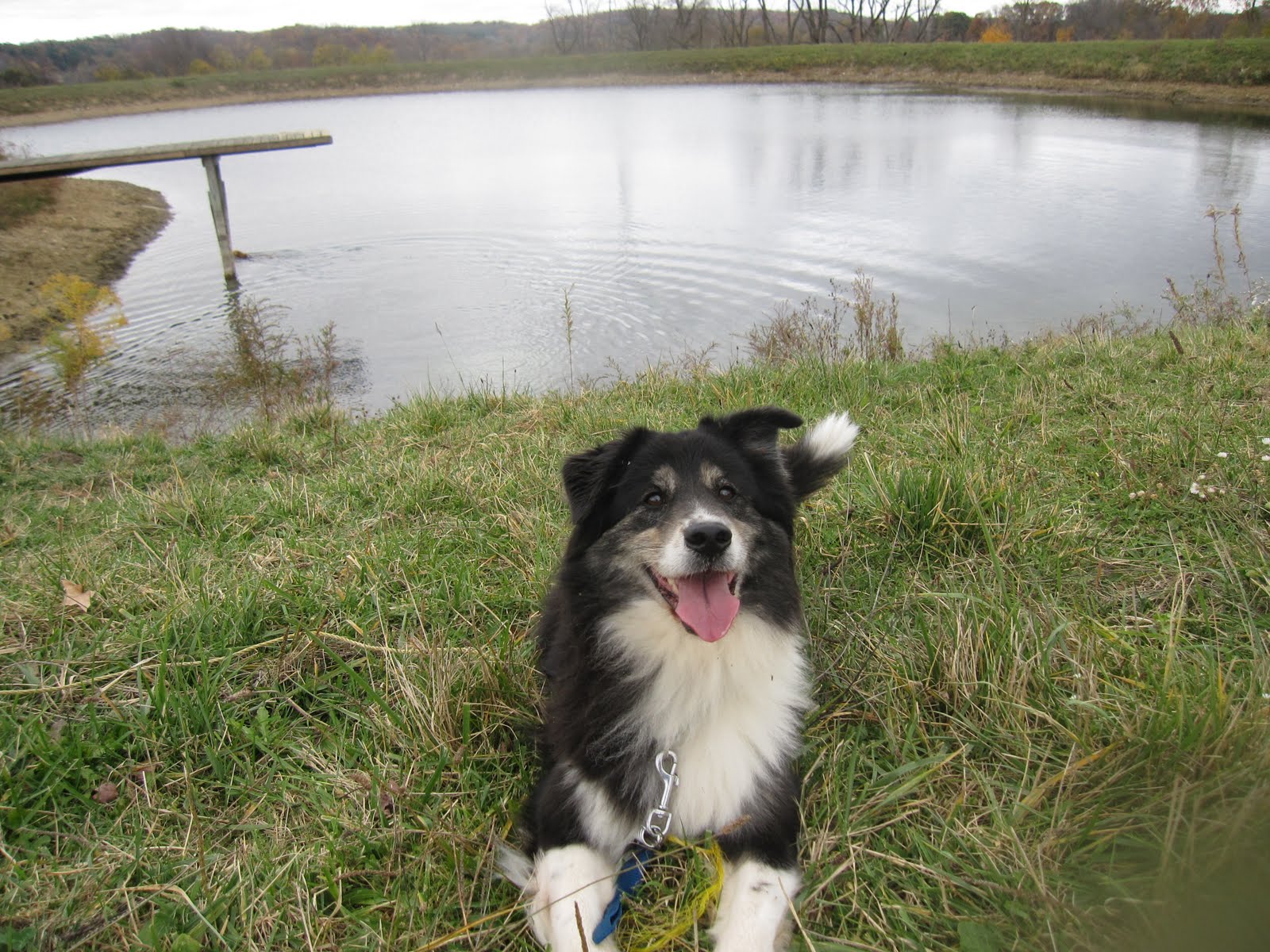 |
| Luna and Griffin both tell me that leash pulling is not a problem if you just let your dog off leash... |
A few initial thoughts on the challenges:
-- By the time people get help for walking training....the dogs have been pulling for quite a while. The humans have continued walking while the dog is pulling, meaning the dog got a TON of reinforcement for the pulling ("Look, it makes the humans walk!").
-- People get into habits and patterns. They want to continue with normal walks during the training period, letting the pulling happen there, and thus compromising the training.
-- It's hard to look at the big picture, all the little times where the dog pulls on leash and the dog is allowed to continue forward. And we miss those moments. I am so guilty of that, today I counted (...after the fact each time, 8 points in our morning routine where reinforcement is distributed without me being careful to have the behavior I want before that reinforcement is delivered.)
Friday, July 8, 2011
Training Animals to Readily Eat
About two years ago, I woke up to Blaze vomiting. He did not eat food offered to him. It could have just been a bad day. He has always been a dog to eat right away when food is presented. If he had vomited from eating something bad...he most likely would have still eaten his meal when offered. I knew something was very wrong and immediately contacted our vet. The vet thought my initial concern of an obstruction was a bit hasty, but the next day Blaze was in surgery. It was an obstruction....from eating a clump of wild animal hair.
With our dogs and even cats, provided everything else seems normal, we get told that not eating isn't a huge deal, offer food later and don't worry. And in reality it's often not an issue.
But think of the advantage you have with a reliable eater. One missed meal and you're very attentive for anything else abnormal. If your pet doesn't eat well? Only bigger signs will stand out and get your attention....probably when things are more serious.
But think of the advantage you have with a reliable eater. One missed meal and you're very attentive for anything else abnormal. If your pet doesn't eat well? Only bigger signs will stand out and get your attention....probably when things are more serious.

Blaze is very enthusiastic about eating when fed. Luna hasn't always been, but currently will eat within 10-15 minutes. I don't know when she last missed a meal. Griffin is not so great. It's nice that he will stop eating when he is full, it's also really annoying. If we don't have our usual activity level, he won't be as hungry, he won't eat much. If we have more than the usual activity level, he gets very, very hungry and a bit noisy and wild.
A few things we think about to get better eaters:
- Check with your vet to rule out any medical complications.
- Be sure you are feeding your pet the proper amount. Many animals who do not eat readily are getting more food than they should have.
- For a period of 2-3+ weeks, have your pet work for all his food through training or food toys. By training, I don't mean, "Sit" and put down the bowl. I have the dog do a behavior for a few pieces of food...and work through the meals. We get HUGE improvement this way.
- For meals fed in a bowl, divide meals into smaller portions so that the animal does eat everything offered.
- During the training period, up the exercise 25+% or more (if your vet okay's it). This will make it a bit harder to determine the amount of food for your pet, but it can help get your pet eating more readily.
- Have your pet eat a small amount of food from a bowl. When the bowl is empty (of the 5-10 pieces or whatnot), give a great treat or play ball or whatever else your pet loves.
- Do not have food freely available.
Tuesday, March 22, 2011
A Week of Training: Monday
Blaze:
- A track. It was short, we went across some brushy areas that normally I walk around. He only hesitated a bit, checking other options before going through. We also had two places where we crossed a road, and he seemed to do fine there. It almost seemed too easy. I'm really worried that I might be accidentally cueing him!
Luna:
- Handling: I've abandoned her claws for two long. We did a bit of work as I clipped her nails. As I well know/knew, she needs work on that. She will tolerate it and that's not really good enough, we want our dogs to love handling
- Tricks: Going over and under Griffin. Over is easier, it's what she learned first. Under goes okay if she's Down and I use a target stick
Griffin:
- Agility: Monday night is advanced agility class, so after lessons, I run Griffin on all the courses. He did well, I didn't. It was sometimes harder to get where I needed to be. However, his behaviors were good, turns were efficient, and he was very, very enthusiastic
- Greetings: We didn't intend to use this and I didn't have food ready, but he did some really really great greetings with 3 different people. They're people he knows and love, I wouldn't do public trips without food at this point, but I'm still impressed he didn't think about jumping at all.
- Stays: While I ate lunch and did computer work, Griffin was sit-staying about 3' away. I'd reinforce at intervals from 3 sec to 25 sec. He did really well, at one point he offered some stands and chin targets to a chair next to him, but we soon got back into the sitstay pattern.
- Cue transfer: At training group, we did a practice of cue transfer (new cue, old cue, behavior, click, feed, and soon the dog is responding to the new cue. We played with transferring his temporary go out cue (Go!) to his new cue (Run!). It went well, in 5 reps he was offering the behavior on the new cue, we did a few other behaviors (spins, downs etc), gave the new cue, and he still responded properly. This got me off on a tangent about our stand not being able to get on a verbal cue.... and then how this is probably the result of too good of stimulus control.
Today I was better about being more specific with each session. Tomorrow we have the morning to work on our own, an afternoon meeting with a newish training group, and then time after evening classes.
Sunday, March 6, 2011
Recalls Part 2: Exercises we use in class
This is the list of the activities we use in class and the typical order. Sometimes the order changes based off of previous training history or how the dog is responding.
Collar Holds: We want this to be very good before we put it with any of the other recall games. We want to practice so much that our dog gets wiggly and happy when we reach for his collar.
- Reach out with a flat hand, to the side of your dog's head. Touch your hand to his collar. Then feed a treat. Repeat multiple times.
- When dog is doing well and never moving away, gradually increase intensity.
- Increase the distance handler moves to the dog.
- Practice reaching over the top of the head to the collar (we want to always go from the side in real life...but other people who don't know better might try to reach over the top).
- Get people your dog knows to practice this too.
Call and Run: Speed of handler and how far the handler goes, depends on what makes the dog happy, dog speed, and space available. Food/toy should NEVER be presented in training until the moment you are ready to reinforce.
- Have a helper hold your dog, or drop a few treats on the ground to distract him as you leave. Talk to your dog in a way that will attract him. When your dog is on his way to you, run away, then stop and scatter a few treats at your side.
- Dogs that like to play can have playtime when the dog arrives.
- Repeat many times, varying how soon/late you run and the distance the handler runs.
Call and Turn: This can be combined with the above, based on handler skill level. The coordinated handler can have treats in the left hand if you will have your dog come to your left. If you want your dog to come to your right, have your reinforcers ready in your right hand. If you are not coordinated, have treats in both hands, just in case you misjudge.
- Have a helper hold your dog, or scatter treats to distract him while you walk away.
- Call your dog (and possibly run). When your dog arrives, turn away from him a quarter of a turn, then scatter treats at your side. If your dog is coming to your left, you will rotate right. If your dog is coming to your right side, you will rotate left.
- Gradually increase the amount of your turn.
- Sometimes, instead of scattering treats, you can toss a big treat ahead at the "moment of reinforcement"
Loose your dog: This game requires some practice of the previous exercise.
- Call your dog, when he is about to reach you, dart away. Feed as soon as he catches up.
- Vary where you are turning.
- Always scatter treats at your side, or toss ahead of you at the "moment of reinforcement"
- When your dog has had many repetitions with one dart away, you can have two changes of direction before reinforcing.
- The more practice the dog tries, the harder you can work to loose your dog. At the same time, always plan it so that your dog will most likely succeed.
And with all of this, we need to remember to use good recall training.
It's interesting that the above exercises are very effective for getting the owners to be good about recalls. Scattering provides more reinforcement than feeding one piece. Turning away not only provides motion to encourage dogs to come, but it gets the dog next to the owner so that the owner is not leaning over the dog. Running gets people to be silly and exciting.
Friday, March 4, 2011
The Best Class Yet
 I don't know if it was because I had an almost normal amount of sleep for the first time in 10 days or if the information from vet conference was finally seeping into my head, or if it was just luck, but class last night was great.
All the dogs made measurable improvement within the hour. All the choices I made were effective, all the dog students were happy, all the human students had a great time.
The night started with a head halter fitting. We picked a color and a size and I shaped the puppy to put her muzzle into the loop. Horray! Less than two minutes! And then while the puppy had a break, the owner was able to practice putting a head halter on a fake dog. Then I did another shaping session with the puppy and the owner had a turn. The team will work all week on putting-it-on-for-treats and putting it on before meals. Next week we'll start walking with it and maybe putting the leash on it too.
In both the 7:00 and 8:00 classes, we started with walking like usual. Some dogs were working on the squirrel game. Some were introducing walking with the "backwards walking" activity. Another was doing pace changes. Puppies were attentive and happy.
We then worked on recalls, while I helped one team, the others worked on reinforcing "more relaxed" behaviors. We talked about what those would be and how we would have to be using a high rate of reinforcment due to the excitement of one dog running. The humans were so good on this. Most of the dogs didn't even stand up. It was amazing. This happened in both classes!
And the recall dogs were great. While we didn't directly talk about "how to train a perfect recall" at vet conference... the things discussed did helped me be very concise and good at pointing out the most important parts to students. We talked about rate of reinforcement, value of reinforcer, and building a solid foundation. Look for more on this another day!
One class had time to do leave it, some dogs were on the first step, others were a few steps into it. Most were wanting to put the cue to it now, so we talked about whether or not we wanted "leave it" to mean "Sniff my hand and back away" or not. As usual, I told my students, "If you want that, I'm okay with it. It's up to you! Personally, I don't want my dog to nose touch my sandwich before backing away, especially if he just did that on a walk to a dead squirrel!"
And then in both classes, we worked on polite greetings. One dog was held by me, getting fed treats and learning it's okay to be with a stranger. And the owners would go to each station and stand at a target, while the dog owners reinforced their dogs for appropriate behaviors.
We talked a little about how to work on greetings at home and then wrapped up for the night.
Usually I walk out thinking about the things that could go better. Exercises I could teach better, places I could be more tag-gy. Exercises I should train differently. Dogs that weren't progressing. Dogs I needed to find ways to lower stress.
But last night was next to perfect.
Subscribe to:
Posts (Atom)