Showing posts with label Competition Obedience. Show all posts

Thursday, January 19, 2012

Griffin's Dilemma

Griffin has many really great competition behaviors.  His real-life, daily-use behaviors are getting a little...rusty.    In a training context we can do some very excessive "proofing" exercises and he is almost 100% successful. When he makes errors, it's often to move -away- from the things he really wants.

Yesterday we worked on his directed jumping.  First a few to see how he was doing. Then with someone else telling us which jump to take.   And then with some proofing exercises.  Initially I had a helper hold him (so no stay to break).  He perceived that as a recall exercise and blasted straight to me.  Once I left him on stays, he was great and then only missed about 2 out of 20 repetitions over the day.  We ended up with people running around the ring and taking the jumps, standing in interested positions, and carrying items through his ring.  He barely looked away from me.  

He can do most of his competition exercises with some fairly extreme distractions.  Yet I do not think he's ready to trial.   In the moment of excessive distractions, Griffin very much knows that it's a trick and he only works harder.  

Attention!
So what do we do?  Next week we'll do more repetitions with more subtle distractions.  We'll do more exercises or pieces before reinforcing.  

Saturday, September 10, 2011

Where to Reinforce on the Go Out

"It depends"  on which part you are working on. These are not the only option and possibly not the best options... but they're  my current favorites.

Looking ahead while at heel:  Release and toss reinforcer forward
Initially leaving your side:  Send and toss reinforcer ahead of the dog, prompting chasing before getting the food toy.
Running out while further away:  Send and have a helper toss a toy out even further ahead of when the dog is at the "far" point.  Or you can try and toss. But only toss if the dog is looking ahead. And monitor to be sure that the dog isn't looking back to you.
A sharp turn back:  Toss the reinfocer in a way that encourages more of a turn after the dog starts.  Griffin turns clockwise, so as he turns to face me, I toss the toy behind him, to my left. 
A sit that creeps forward:   Behind where you want the dog (practice with ring gate posts but not all the fencing so that the dog doesn't have to jump the fence to go get his toy/treat).  
The launch back after the sit:   Release from the sit, toss the toy in the direction the dog is to go.
The duration/stickyness of the sit:  Run in and feed or play...  gradually adding in duration. Same thing can be done with then tossing away, but if the duration is really a problem, it's best to be reinforcing in position to get the behavior more 'sticky'.

Wednesday, June 29, 2011

Griffin at CD Prep Class VII

We skipped two weeks for camp..... I probably would not have signed up for the class if I had known ahead of time that we would be such poor students.... but I'm very glad that we've been going.

Tonight we talked a bit about the next options for class and on the topic of maintaining criteria.
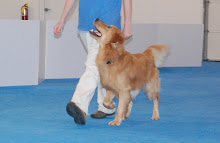
Golden retrievers who love chewing.

We did some group heelwork, I stopped frequently to play with Griffin. It was really hard because his tugging would upset the other dogs if he was too close to them so I had to be sure to maintain enough distance that they would be okay and not get in trouble due to my dog being rambunctious.      Griffin's actual heeling wasn't that great, I ended up reinforcing as soon as he was in position.

The next things we did were individual heeling patterns and figure 8.  Griffin's heeling was pretty great. I talked to him at a few places but did not feed during the pattern.   Afterwards, I did a bit more heeling with frequent reinforcement. I don't want to be going too long between reinforcement yet.    Our 180* about turns and our 90* turns both need work.    The figure 8 was  a bit of a disaster. He wasn't working hard to maintain position. I was sloppy and reinforcing with my left hand, resulting in a forging dog.

Stays:   Our stand for exam was half decent. Feet moved on one rep out of six. We were able to have the "judge" pat him on the shoulder.    Other stays, he started out barking.  The instructor wanted me to return to him right away. I wanted to wait for a pause.   We moved further away and he did well....still need more work.

Recalls:  We did an exercise where all the dogs were staying and being called to front at the same time, but at different angles.  Griffin broke his stay once and twice he left when the judge called, not when I called.   He DID always leave his stay to me....the best type of mistake he could make.   "Leaving on the judges signal, not the handler signal" is a common theme this week.

On our to-do list after this class:
-Increase stay distractions and auditory proofing
- Stays with 'pressure' of interesting things to either side.   Ideally this would include other dogs, but we probably won't have any to practice with.
- About turns, with and without my dog.
- Figure 8/serpentines/loops, maintaining heel position
- Back to reviewing his physical therapy notes and-or another consult....his fronts were straight other than that back left foot sticking out a bit.  
- Get rid of the head tilt on his fronts.   It's not an always thing, maybe 20% of the time....he will turn his head while his body stays in position.
- Recalls with various types of distractions.

We're on the fence about doing the class again. It's good to get me out and keep us working, but it's a bit of a drive and takes away from work/other activity time.    Plus with the heat...he just doesn't work as well as he does when it's cooler.   We have a few days to make a decision....I'm on the fence!

Bonus news: He did his first public scent demo, along with two others we train with.  As usual, he was adorable (something the people noted at the demo as well as his obed instructor!). He worked so well, very focused, even when we had the kids standing nearby (meowing) as distractions.   Best dog.

Wednesday, June 15, 2011

Straight Sits

The 4H Agility Games Clinic went quite well yesterday. I had fun with the kids.  We did a more beginner group in the morning and a bit more advanced group in the afternoon.  We were able to stick right to schedule, and if anything, I had a bit of extra time.

During lunch, one of the kids asked about straight sits for Obedience. Her dog has a tendency to sit crooked.   Both the kid and parent spent quite a while telling me about this and how it definitely was the dog just not wanting to sit straight.   

- "He's always done it."   So....it's possibly been reinforced a ton from the humans.   And there could be a physical cause contributing to the behavior.....something more serious like Hip Displaysia, or just the dog's general conformation making it more uncomfortable for him to sit square.
- "He especially doesn't like to sit on mulch."     If you were wearing a swim suit....would you want to sit on mulch?  Remember...your dog is very short haired!   Sitting on cold, hot, pointy, pokey, wet things is not going to be fun.
- "In training we do heeling and then sit"    It's good training to do one thing at a time.  Do you want to fix your sit, or practice automatic sits in heeling, or work on heeling?   If I were in your situation, I would do a lot of sit training separate from heeling, separate from stays, separate from other things....until the straight sit is fixed.
- "We're worried the judge would take off a lot of points."    Not in rally, and likely not much, if any, in obedience.  Watching you work, I would be more conerned about how you pull the leash every time you stop....that's 1-3* points every single time. I would be more concerned about your dog not sitting at all.... 1-3 points.    I would be more concerned about your dog not being parallel with you. You have to set your own priorities.
- "He just doesn't want to do it."   There area  lot of reasons he might not want to....but what you're saying also tells me he thinks it is not worth it.  If I asked you to reach in a big muddy gross pile to get a penny, would you do it?   ("No!")   If it was a thousand dollars?  ("Yes!")   We need to have a reinforcement history. We need to have reinforced your dog for sitting with such good reinforcement and so many times that he will sit no matter what.    My dog Griffin isn't the smartest dog...he's not stupid either.  But he does some silly things due to his reinforcement history.  One day I asked him to put his feet up against a solid wall.....and as "up" usually means get in the car or on a bed....  he put ALL four feet on that wall....looked at me in a panic...and fell.    His reinforcement history for "up" was so good, so strong, that he responded no matter what...until gravity intervened.
- "He really is stubborn."     Maybe there are other contributing factors, like core strength....we can do exercise ball work or that sort of thing to build his physical ability. He is a very athletic working dog, but his types of activities, the types of terrain he works on, the things he does....may not be what he needs for the strength to do this.
-"In his previous competition training, for other sports, he was punished every time he sat."  Then you're doing  a great job to get sits.... we need to improve his history of reinforcement, really get things to pay off.

And then they demonstrated.  The dog sat straight 5/5 times.  The reinforcement?  Came a good 10 seconds after. I demonstrated how to have the food ready and how to give several pieces, very quickly in succession, for the completion of this sit.  Latency, how long it took the dog to respond, and the speed of the behavior were both lacking. 

Griffin worked a bit during lunch.  Outdoors, a rally course was set up.  He wanted to sniff the grass at the start line.  After a minute of sniffing I gave up and led him by the collar inside.  He worked much better there....some bobbles due to drains on the floor and other little things....his about turns lacking.    A few people sitting around clapped for his left turns and later were thinking we were crazy to not be trialing yet.   They didn't see him work outside and probably think I'm too picky about my criteria.     But for obedience....we really do need to "Maintain Criteria!"  I was very happy with how quickly he got to work indoors....and then last night after class, he was just brilliant.   I haven't gone back to watch the video....I'm afraid to see that he wasn't as great as I'd thought!

*While 4H scoring is supposed to be like AKC/UKC/etc..... it's not always....

Wednesday, June 8, 2011

Griffin at CD Prep Class IV

We're almost done with class!  I miss the next two weeks and then one week left.   Somehow I mis-counted when I registered, I thought I would miss one class and just the very last week.  My counts were very off!

Tonight half the class was away at big shows, there were just two of us present. I almost had stayed at Training Group (in air conditioning!), but was a good student and came despite the 90* weather.

We started with some big looping heeling.  This was the easiest thing for me. I like being able to go and reinforce the specifics I like. Griffin did well with it. I was careful to stop to let him eat the treats and then only walk forward once he was ready.

Our next heeling activity was taking steps forward and then steps sideways.  This went well but it's so hard to do without turning my head or shoulders.  I don't like having to turn to see that he is parallel. I'm fairly confident on when he is parallel if we are going in a straight line, but when we're doing sidepasses, I don't trust Griffin to keep his back feet tucked in yet.

The following exercise was a big surprise to me, I was sure Griffin would do it.  We were supposed to get spins in both directions while heeling, and then add it into turning corners.  He is 100% in front of me and was 8% next to me. We tried to quick re-get, some in front, somewhat angles, and then next to me.   Not so great.  

We did a few sets of stays, some by ourself, the other dog doing Beginner Novice stays, and then some group stays.   The group stays...we had a brand new dog sit next to Griffin, he started moving to the dog twice...we moved a bit further away and he was good. He broke his eye contact to me a few times to watch things going on, but quickly looked back.  One almost-whine and a bit of shifting his head and front feet.

Stand for Exams: We did a few passes with the instructor walking a path 4' away. Horray.  Griffin did not move in response to her.  But he did move after I marked and before I could get up to him to feed. I was moving too fast going back to reinforce.

Figure 8's were interesting, the instructor does it a bit differently than me, cueing the turns 2-3 steps earlier than what I had been doing.   It was a little hard to adjust to... I'll experiment with this a little to see which works better.

Last was a few sets of recalls, what the instructor titles "Fun Recalls" and then a real one.   I'm not doing recalls to me and between my legs, I want him coming to me with his head up, no ducking down thoughts ever.  And I find the other variations painful....walk forward and back to the dog.  Release and run around.  Get the dog excited, yet stationary, and release to a tossed treat.   It felt messy at times, like he was watching my unintentional body language more than my intended cues.

We'll get to do some more training at camps over the next few weeks.  We aren't forgetting our obedience while we're gone.

A few thoughts after class:
- Some of the heeling activities ("Drills") and recall activities are to get us to be unpredictable and fun.  While Fun is never a bad thing.... I'm conflicted on the unpredictable part. I can understand the benefits and the long tradition of this being part of dog training.  But it's a bit painful for me. I think I want my dog to know what is next, I want him to be able to predict so he can respond to cues as quickly and immediately as possible, without having to think.   Or is the benefit of being able to respond to cues no matter what order, variable, etc....   more worthwhile?
- As I've mentioned recently.... markers are important.   In the first week of class, I tried to just reinforce things the way the instructor wanted. I don't want to be a trouble maker.  But without a distinct marker, my dog was watching my hands too much and trying to predict when my hand would move to his mouth.   Since then I've been trying hard to use a good verbal marker.  Things have improved.
- Stays:   Are progressing. Slowly.

Wednesday, May 18, 2011

Griffin at CD Prep Class


We had our first night of class. The instructor is very experienced with competition obedience and obviously loved to teach.

Griffin and I were bad students, we had missed our exit and arrived 15 minutes late. Not a good start!

We did some heeling, the exercises mostly had a lot of luring to prevent the dog from making errors. I'll be practicing my treat transport (from _Agility Right From the Start_) so that we can get through these exercises better.

The class does two sets of stays every week. He did well with the distraction elements and surprisingly well with the duration (I was going back to feed often). He did roll on the down right before I returned. It was cute and horrible at the same time.

For the recall, we worked on dog attention before being called, some of the variations were treats tossed to the dog, away from the dog, and the handler creeping away. This was really hard for both of us.... the tossing of treats without a solid marker started in a bad habit of eyeing the treat hand. I'll have to establish a good verbal marker before next week so this doesn't get as messy...the one I was trying to use didn't work very well.

We did a set of stay challenges, leash pulling and dropped treats. Both are things we've done before and Griffin was very cute performing well. We'll have to re-visit the treat dropping exercise.... I think it was different with me sitting on the floor rather than standing like usual. I'm always conflicted on the leash pulling exercise...I want my dog responsive to slight leash pressure for our walking, but it's a good challenge.

Our first goal for next week will be to be on time.... our second goal is increased focus. He wasn't horrible, but there was more external interest than I had expected. If we can get there a bit early we'll be better prepared and settled and hopefully can work in more toy play than we did tonight.

Earlier in the day, at training group, we did stand for exams (more prance than I'd like...with NO ONE else nearby), CGC style greetings (he was playing helper dog and was PERFECT!), and restrained recalls to front (perfect).

Other things I noted: His kick back stand has gotten a bit sloppy. His relaxed down needs to be on cue.

Thursday, January 27, 2011

Using Platforms for Training the Directed Retrieve

Michele Pouliot has done presentations at ClickerExpo about using platforms to teach behaviors. I haven’t yet been able to go to that presentation (or to watch her new DVD on the topic), but I have been utilizing platforms in my own ways!


We warmed up with go-outs to a platform. And then I added in sending my dog from a sit to the platform.

For retriever-y activities, my understanding is that he has to turn back in the direction indicated. Or more, that it’s desirable for some specific reason. Horray! Once he was doing this well, I placed a platform off to (my) right.

We continued to use the back platform, to be sure he would not be immediately drawn to the new one. The first few responses his turns were, strategically, away from the side platform. And then we tried back-turns towards the platform. All correct!

Unsurprisingly, it was difficult for him to actually go to the side platform. I helped him out and he did better.

We did a few other games with this, I might post later, and then we worked with a directed retrieve set up.

Previously, our work with the directed retrieve had progressed to something 10-20 feet directly to our left, same distance out front, same to my right. But when we tried to decrease the angles, we had more errors than I would like.

The platforms provided a way to break down the behavior (“Go where indicated.”) without the retrieve part. I didn’t want to risk damaging our retrieve with the incorrect responses we may get.

Surprisingly, he had 5/5 correct responses. I edited enough to take out our playing and set up. I was very surprised he was doing so well!

We’ll do more sessions like this and then substitute item/s for the platforms. Or possibly on the platforms (but would that damage our platform behavior (a foot touch, he doesn’t have to sit unless cued). And hopefully it goes as well as it should in theory!

Sunday, January 23, 2011

How we did not go to an APDT trial.

Last month: "I'll go two days! I'll do two runs Saturday and one on Sunday with Griffin, and Blaze once each day."

Two weeks ago: "I missed pre entries. That's okay, we can still do day of trial entries. I'll go just one day. One run each dog."

Last week: "I'll take just dog. Blaze? Or Griffin? Maybe I'll take them both and decide when we get there and do a few test warm up minutes."

Last Wednesday after off-leash class: "Okay. Griffin isn't really ready for the environment. That's okay. Blaze has had enough training he should do well."

Last night before practice: "Great, I can't wait! He's had enough training it should go smoothly."

Last night after practice: "Wow, it's good I can count, otherwise I would think I'm missing a finger. Or two. Okay. I'm not going to take Blaze. Maybe I'll stay home."

Megan last night: "If I have to go to the trial, you have to go to a trial."
Me: "Okay. We'll see."

Me half-asleep last night: "I'll take Griffin. If we can get from the car to the ring, we should be good. Yeah. That's what I'll do."

Me this morning: "Uh no. Too cold. Not ready. Sleep in."

And so I did not go. I wish I would have. I probably should have. But maybe not. We're not quite ready in some ways. But we're over ready in others.

My compromise was to do an obedience run through tonight between lessons


Hours later I realized I didn't do heeling pace changes. And I did the stays but no video as that's completly boring. We should be ready. Eventually. We had great parts (duration of heeling) and not so great (the stays and SFE foot twitches) and smaller not so great parts (a few bumps on heeling and the completely lost piece during heeling. And my twitching.

Horray for Griffin's brother who got his OTCH today. It only took a year from CD to OTCH! We're very proud.

Tuesday, January 18, 2011

Scent Article Part II


We have training friends who have a lot of experience training dogs for scent work. And so we asked about Griffin's inability to find metal. Griffin will not find a hidden metal item unless he happens upon it by luck, but he'll easily find a wood, plastic, or cloth item in the same location. It seemed to me that he really couldn't smell it.

that said, dogs have amazing noses. Surely skin cells would get caught in the ridges of the canning lids? And he really had to be able to smell it somehow.

But after trying a few things, including the set up they use for scent work (scent in a jar in a cement block... with some specific set ups and handling). And he accidently smelled at the right one. Click! Feed in position. And shortly he started to paw at/try to retrieve. But not just to the 'right' one. He did it to both. We didn't notice different postures at either block.

So we concluded that it's really not a hugely powerful scent. That it's such a small amount and something that dogs are exposed to every day. And that it's just a really difficult exercise/concept for any dog.

The recommended progression was to get a peg board and tie down wood articles (clean) and tie down one scented. Reinforce for accidental and intentional indications to the 'right' one. Remove and replace the scented article to different areas. And continue to reinforce for nose touches/teeth on the correct item.

Monday, January 10, 2011

Looking at Heeling: Pace changes

At the obedience seminar last weekend we had a whole afternoon on heeling. The really interesting part, is that while I can also talk about heeling for hours, I would have set up completely different activities!

Some of the activities in that part of the workshop were teaching the dog to circle to the left, the dog to do leg weaves, the handler reinforcing the dog as he moves into position, pivot box, and exaggerating shoulder cues when weaving.

The only one of those that I frequently use (and use a TON) is the pivot box exercise. I absolutely love this and see it as the key for solving almost all heeling problems, as well as left finishes.

My second mainstay for heeling is pace changes. Obviously in competition obedience and in rally that corresponds to pace change exercises, but it's also relevant on all turns, serpentines, figure 8, etc. My understanding is that a dog who is lagging or forging on turns (1) Doesn't understand heel position well enough, and the pivot box can improve that and-or (2) the dog doesn't understand about matching the handler's pace.*

We always pick one pace change to do multiple times (normal TO fast or slow TO normal or Normal to Slow or fast to normal) and click as soon as the dog indicates he is matching the handler's pace. Everyone wants to look for duration, but we really want to reinforce the dog for 'matching' at this early stage.


We only work on that one pace change at a time, but after a short break, we can work on a different one. When the dogs have had sufficient practice, we go to working on serpentines and every time the handler crosses the serpentine and the dog moves to match, we click and feed.

The third exercise we do is for the handlers. Typically we run this without dogs and then put the dogs back in. We use various tag points to get a good 'picture' with the handler. We look at where the person is looking (straight, ahead, a number of feet in front), for specific leash holds, shoulders over hips, steady pace, small steps before halts... And there are sets of tag points used for each of these as needed.

It was great to see how others saw the "smallest pieces" of behaviors and to re-look at how I teach competitions behaviors. It's always a challenge to look at the best, fastest, most clear, and most efficient pieces and note any changes based on different dogs and owners and their learning styles.

*And of course that's all in theory...dogs like to give us challenges and there are exceptions to the rule and other pieces we add or work on


Heeling is great!

Friday, December 24, 2010

Obedience and Agility Pieces

After last night at obedience class, I have a list of skills we are lacking in, but that also made me pull out the list of all the obedience skills we need to work on and we ran through some of those this afternoon.

- Go Outs: Still at using the foot target stage. I'll need to work on getting speed up. If he runs, he does well, understandably, and if he's moving slower, he's less likely to make it. The sit part is beautiful. Today we did a number of reps and then hid the foot target under a mat. He wanted to scratch rather than sit on it, but the second time was great and we probably could have taken it away. He went out about 30'!

- Retrieve: We did a few on the flat. Beautiful pick ups. Nice movement back. Sit was slightly off.

- Directed Retrieve: We probably haven't work on this since late last winter. So on rep 2, we went to one 15' to my right and one 15' to my left, dog facing me, and I sent him. We changed the angle ( objects more behind me) and then I was in heel and sent him. We should do this with foot targets rather than retrieve objects for a while to get more proficiency.

- Stand: We tried to get a better hop and stick in place, clicking when his front feet hit the ground. And theoretically extending the time. Handler still other than re-sets. And hopefully my motion can be added back in

- Exam part...: Very good. He looked completely still for almost all the repetitions. The 2-3 times he moved, it was towards me/away from the person.


And then we went and worked on some agility skills. He's adorable. He is surprisingly proficient on so many skills, I just don't always remember how much help or not he needs. It's interesting to see where he is fluent and where he isn't, he wasn't able to perform a few skills at a distance, but another whole set of cues he was able to respond to with a completely new handler who hadn't ever done agility. Given the right cues, he performed how he should. It's fun that he is so comfortable working with other people.

Thursday, December 23, 2010

Griffin's Night at Competition Obedience Class

In the afternoon we had training group, and per the new plan, let him in the back yard for 2 minutes (he rolled around and lifted his leg on a few spots). And then back inside. He ran off to the door only once and that was when his ball went over there.

We did some agility and some obedience, he was pretty good though the flyball has started a few habits that we might need to change. He's powering down any line of jumps towards a tunnel without responding to my cues. But in other set ups he's doing well and even then we can fake it with exaggerated cues.


And then we drove half an hour north to our first competition obedience class! It was somewhat like run throughs, there were a few group parts where the instructor would call out what to be doing, and then we did some individual work and then group stays.

Initially: Poor focus, checking out things on the floor. I'd pause and wait for him to respond and reinforce. This got better the longer we were in class.
Set ups: Needed more help than he should have. I shouldn't have had to help him at all. If we heeled underneath ornaments hanging from the ceiling he would think vertical thoughts. It was pretty silly.
About Turns: He had trouble if he saw something else going on but was otherwise tight.
Fig 8: Wider than he is on straight lines, but still very reasonable. I think we will tighten this up
Stand for Exam: His 'judge' walked past him 3 times, no movement, one with a pause next to him. No movement but a few tail wags. Second turn, he did a little figiting on approach but if I left him, he would stay still while she walked past. Next 3 reps were good.
Recall: First one was about 10 feet, dropped leash. Very good. Second one was leash off and 20ish feet. Slightly crooked front. But very slight.
Dumbbell: I had someone hold his leash, I dropped the dumbbell about 10' away and then went 10' past. I called, he picked it up and came to me. We repeated 3 times, his speed improved. We've done harder variations at training group, but I wasn't about to push him too much in this class.
Retrieve over jump: I wasn't going to try it though he probably would have. I had him hold while I went to the other side and called. First one he was holding it POORLY...but did not figit! and somehow made it over the jump and to front. The next two tries he went around, so I did it without the dummbell and he HURRIED to me!
Stays: I stayed away from the group, they're way more advanced. I fed as often as needed. Stays need a lot of work. He stayed while people walked past but duration was poor and he got figity.

I hope we're able to somehow go back but I definitely know what our weak places in training are.