Cues mean more than a history of reinforcement if a specific behavior occurs. Cues can give so much information to the animal!
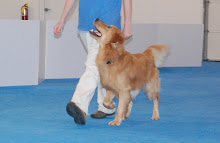
Griffin and I have been working on and off on his "Drop on Recall" obedience exercise. We do a session. It goes poorly. I come back to it a few months later. But something has happened and now he -gets- it.
And not only does he understand, but the behavior is NOT contaminating our regular recall in any way.
If Griffin is on a SitStay and I cue Front....he runs up and sits in front of me. If he's in a SitStay and I cue either Dog or Here, he will trot forward and drop when asked. Sometimes on the Here/Dog he will anticipate and drop on his own (I walk to reset).
The really cool part though.... no matter how many drops we do in a row, if I cue Front, he NEVER slows, he NEVER makes an error, he NEVER thinks about dropping. We've kept that cue clean and the criteria is so clear to him that the similar drop behavior is not impacting the straight recall.
It's amazing!
(A video from last year when I was using a slow motion feature to look at how dogs lie down:)
http://www.youtube.com/watch?v=EDrb9QpYxcg&feature=channel_video_title
Showing posts with label Cue. Show all posts
Showing posts with label Cue. Show all posts
Friday, August 12, 2011

Wednesday, June 29, 2011
Other People Handling My Dog
In a Monday night class, we talked briefly about the benefits and risks of other people handling and cueing Griffin.
Griffin was added to my home to be my competition (obedience and agility especially!) dog.... but also my demo dog and to go out and help me help other people learn about training and dogs. Both are very important, almost equally important and possibly a bit contradictory.
Other people cuing Griffin runs the risk of Griffin learning to generalize. He might responding to cues I would not normally want to be cues. He might start giving poor behaviors or responding incorrectly. And he may be reinforced for it. This could hurt his behaviors and hurt the concepts he understands.
At the same time... I do what I can to preserve our cues and behaviors.
- Performance and Casual cues: I don't give away my special, "sacred," unique competition cues. I show people things that are not as important.*
- Supervision: I can specify what things we will or will not reinforce, so the new trainers are doing things correctly.
- Consistency: I am careful that when - I- train, I do not accept poor responses. Dogs can and do learn that different people have different requirements. I want to be very clear with what I expect and always expect.
- Fluency: In some ways, his response to cues given by other people show that he has behaviors with a high level of fluency. He really gets it. The behavior is proficient. I can see what parts of the cue are relevant to the behavior and which are not.
- Discrimination: At the same time, there are some behaviors and situations where I do not want him to respond to cues given by other people (competition obedience). So, I don't give away these cues. We don't work on these behaviors in the other-people-handling environment.
I also recognize the benefits of this environment for Griffin. He is learning to be even better behaved around kids. He's learning to engage with people. I am recalling him back to me on a regular basis, meaning great recall training opportunities. I can see which behaviors are strong, and which behaviors are not strong.
Last week, at the 4H Teen Camp, Luna's job was to come out during lunch. She's too shy to steal a supervised sandwich, but she would go around to the kids to solicit food. They could ask for behaviors she knows well (Sit, Down, Spin, Wave). They would reinforcer her with a piece of food. The kids were fairly stationary and sitting to eat, meaning they were not as likely to startle her compared to the usual activities. By the last day, she was more enthusiastic, working harder, and less anxious compared to earlier in the week.
 |
| Tired Luna. |
There is the benefit for the people involved. Cueing and handling a skilled dog is a very different experience than working with a less experienced dog. It can help give a good picture of the final behavior, how discrete cues can be. How to shape behaviors and add cues. In some ways, there is less risk of "messing up" the dog than with a beginner dog.
The kids we played with on Monday, learned to quietly give a cue. They learned to reinforce the behavior. They learned to start out with the exercise as easy as possible. They learned to interact with dogs and had a good time with a dog. And all of that is -so- important. And in the long run, way more important than Griffin doing his beautiful competition behaviors. That is why I'm so happy to have other people handle and train and play with my dogs.
Wednesday, April 13, 2011
Adding Cues: Two examples

We typically add our cues after the behavior is established.
I've come across a few very 'elegant' examples of cueing that I emailed to Megan this morning.... but the world would probably enjoy them too.
Steve White only adds in the tracking harness after the tracking behavior is fairly well established. Lining the harness cue to the behavior of tracking.
I was reading a book that talked about how a group of math teachers only add in the terminology cues/names AFTER the students have been practicing the skill and have an understanding of it. They don't need the name to be able to do the skill... but the cue/name is put to it after they 'get it'.
The simplicity and brilliance with both of these makes me so very, very happy. Why didn't I think of these?!
Saturday, December 18, 2010
Cues and Precision
Today's training group discussion?
Precision and cues and discrimination. We talked about so much that it's really hard to think about it all and remember all the details. And instead of coming away with answers, I have more questions and confusion and decisions to make.
A list of today's exciting and questioning moments.
1. How much perfect cue-response is needed in agility? Is it beneficial to have obstacles on complete verbal control? On visual cues only with minimal exaggeration? And even though we don't need that, it has to help with fluency to some extent. And so is it a beneficial exercise, or at least for Griffin?
2. What are handling systems really about? I'm an instructor! I've been an enthusiast for years! But I still can't adequately evaluate or explain agility handling systems. The benefits, yes. Consistent cueing!
3. How do we efficiently teach fine discriminations? Not so fine discriminations? There's a lot of theory and I've made and used a lot of training plans. But I don't know what's really most efficient or what holds the strongest! How important is it if I use two different reinforcers? If we start with the obstacles close together or far away? If we only train one, only the other, and gradually mix up what we're cueing for?
4. If we're sending a dog on a line and something is just off to the side, is the dog really going ahead to the jump and learning about leaving things and jumping, or is he just doing what was reinforced so many times? When is it best to add stimulus control?
5. With stimulus control and a table, do you reinforce as the dog is on the table, jumping for it, or lying down? Do we degrade or loose our down performance if we click the jump? If we wait for the auto (and fast) down, is it less efficient than clicking for the jump?
6. Are Griffin and I suffering from poor recalls? a "poor relationship"? Poor obstacle focus? Poor sequence training? Or poor fluency?! Or poor cuing?!
7. Where does Kay Laurence's -train at home to high levels of fluency and then my dog performs well in trials- piece come in? Why do so many have trouble replicating that?
When I started learning about dog training...there was so much to learn. And now I know a lot. And not as much info is new to me. But all these fine little pieces! It's so hard to know exactly what the options are and what the results are. And no one seems to have certain answers. Every training session and every class and every workshop has me going home with more questions, confusion, and too much training to do. Behavior is so simple and so complicated!
Subscribe to:
Posts (Atom)