Showing posts with label Training Plan. Show all posts

Friday, February 17, 2012

Wild Puppy Moments

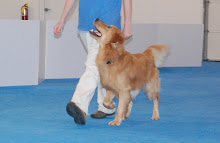
Many of my clients have adolescents or puppies. Most of those have a regular complaint of the puppy going wild, either in the house (often in the evening) or on walks. The puppy runs around, tail between his legs, as fast as he can, frenzied, sometimes jumping and nipping at people as he passes.  This lasts a few minutes at a time and it's almost impossible for them to stop the puppy.

First things:
  • This is normal puppy behavior. Some dogs do it even as adults.  It does not mean your puppy is broken or wild or evil.  
  • We can reduce it and teach your puppy appropriate ways to express himself.  
  • In 10-12+ years when your dog is a senior with increasingly limited mobility, you will say "I would do anything to see him do that again."   Smile and enjoy it.
Second things:
  • Note patterns. Most puppies do this at a specific time of day or specific location on walks.
  • Find appropriate ways for your puppy to run wild. Maybe this is in the yard playing fetch or setting up a playtime with a dog friend, or playing recall games at the park.
  • Make decisions with your family about how much you will limit this behavior. Maybe not in the house but it's okay outside. Maybe in the yard, but not on walks.
Third things:
  • Walks:  Often this will happen at specific locations or with specific triggers.  If you aren't feeling so great or if you are wanting to train an alternate behavior, avoid this area/those triggers for now.  Luna will always start doing laps around me at a specific location. If I'm not up for it, we don't walk there. If you absolutely must walk through/past the area/triggers, start a Treat Transport (constant nibbling of a treat in your hand, practice at home, from my favorite book) -before- you're at the trouble area.  For Luna, that would start 30' before The Area.  Continue for a safe distance past before giving a few treats and continuing on the walk.
  • Encourage it: If the timing is appropriate, use this behavior! It never lasts long.  Think of how you and your dog will feel if you're doing this together rather than battling each other.  With Luna, I would say "RUN RUN RUN" as I walked in a circle and she went around me.  Sometimes I would encourage her to change direction or freeze in position, getting a response freeze from her and she would dart off again.  If your puppy is mouthy, pull out a toy.
Prevent It:
  • In the house, with small kids, this can be very inappropriate.  We often see the running wild in the evenings as the family settles  It's really annoying for most families.
  • Provide exercise and entertainment 30 minutes before the normal "wild time.".  Meet your puppy's exercise/energy needs ahead of time. 
  • Provide structure and feedback on what to do.  Maybe while you're watching TV, be feeding your puppy his dinner, a few pieces at a time, for lying at your feet.  Start out with a stream of treats and then gradually slow down the stream.
  • Prevent access:  Before run-wild time, put your puppy in his crate with a great chew toy.  This isn't a punishment, it's a preventative measure. In some households, this is a key to preventing frustration with the puppy and to prevent the puppy from practicing inappropriate behaviors. Some puppies are wild when they are tired and don't know how to settle themselves. 
If your puppy starts...you have a few options:
  • Encourage it: With your voice, body language, and toys.  They can't keep it up for long. Your dog will enjoy this time with you and only be more interested in you in the future.  
  • Leave the room: Not as a punishment, but to prevent the humans from reinforcing the behavior. The yelling, grabbing, pushing, and having clothing to nip can all be things puppies love.  If you are inaccessible and non responsive, your puppy won't be getting further enjoyment.  The wild-ness will run it's course and your puppy will likely soon settle.
  • Stop it:  If there's a true reason (glass on the floor, elderly visitor just arrived, ?), toss a handfull of really great treats on the floor in front of your puppy as he is passing. He will stop to eat them. Grab his collar. Let him eat a few more. And then Treat Transport him to his crate. The intent is not to punish him, but to put him in a safe place for the moment.   Yes, throwing treats at him may reinforce the behavior.  But if it is truely important to stop him, this is probably the safest, fastest, and least confrontational strategy.  If you are having to do this more than once every 7-10 days, you will need to revisit your training and management plan.

Saturday, November 26, 2011

When Nail Trim Training Doesn't Go Well

It's important for dogs to not just tolerate, but to willingly participate in nail trims.  But even following a good training plan, sometimes it just doesn't seem to work.  Now what?

Your Dog Doesn't Understand:  Maybe at some point in the process, your dog stopped participating and just tolerated the process. At what stage was the behavior -not- loopy, being offered right after you reinforced? When did your dog start hesitating?  Go back through and be careful to work only under the threshold of "participating" not that threshold of "tolerating."
Your Dog is Not Sufficiently Motivated: Some dogs have more sensitivity, making the nail trims uncomfortable.  Often a higher value reinforcer or a greater history of reinforcement can help to motivate your dog to participate.
Your Dog Is Not Physically or Mentally Capable:  Maybe your nail clippers are not sharp enough or you are moving the leg/paw in a way that is uncomfortable.  Is there a way to make the situation look different?


Some dogs do seem to be more sensitive to pressure on the foot or nail. Dull nail clippers only make the problem worse.   Dogs don't move in all directions and many dog owners will unintentionally move the dog's paw in a way that isn't all that comfortable for him.

When I was grooming, the preferred-by-dogs way was to have the dog standing. Move the foot backwards and flip the toes up (think "like a horse"). Be sure to keep the paw/leg underneath the body and to not pull it out to the side.

One of the shelter dogs who went from growly to pretty great has recently stopped participating. She'll let me clip a nail or two but isn't enjoying it like she used to. She doesn't move as well as she was before.  Her arthritis is getting worse...and moving her toes/feet to get a good angle is uncomfortable.   Some fresh-cooked chicken did motivate her to be a participant today.

Monday, August 15, 2011

"What was hard?"

After leash reactivity class we try to always ask "Which part was the best and which part was the hardest?"

It's very, very interesting how most people will then tell the best part.. and the "worst" part.

Part of that probably is that "worst" is considered to be the opposite of "best"....and so it just comes out.   It also just seems like a very human thing to do... to perceive the question as where the errors/mistakes/fault could be.

We ask the question so that the following week can be set up to decrease that difficulty, if at all possible, and then work through it.   And also to keep the owners thinking about what is easier or harder for the dog.  Sometimes someone will say that none of it was hard.  If I had seen that the dog -was- finding parts to be more difficult, I can prompt with, "Were there any exercises that seemed to be a little more difficult than the others?"

The difference in the questions is very important.  The "worst" part (not responding to a cue, barking, getting stiff when another dog barks, etc) is not always the "hardest" part (-when- another dog barked, -when- we got really far from the opening, -when- we were turning away).   "Hardest part" tends to be something about the handler's choices or the environment.   "Worst" parts are typically about incorrect or poor responses...and while we definitely have to consider these....     it's the environment and handler that we can change.  And to change the environment and handler, we have to know what parts were harder and what components led to making things too hard for the dog.

I try to ask the "best and hardest" questions after all of my own training sessions.  Griffin has been really great for the last few days.   But a few of his behaviors hinted they could be weaker than I thought. He didn't make errors, he met criteria, and I couldn't even say how the behavior was different.  Something wasn't quite how it should be....and I make a note of these weaker areas so that I can address them separately.

Thursday, July 21, 2011

A few quick notes on chaining:

There are many different ways to put multiple behaviors.

It is important that we train each separate part to fluency ("perfection") before we start to put it together. If we have a weak piece, the whole chain may fail.

Let's consider a chain of A-B-C-D-E, that is always done in the same order.  When we put this together, we have a few options to put it together.  Here are the ones I can come up with:
  • Work on adding in the consecutive order. As you work through the chain, you start with the most reinforced, strongest point and move towards what your dog knows less well.  A-Reinforce, repeat many times. A-B-Reinforce, repeat many times. A-B-C-Reinforce, repeat many times. A-B-C-D-Reinforce, repeat many times. A-B-C-D-E-Reinforce, repeat many times.
  • Adding parts, starting at the end.  Backchaining. As your dog goes through the chain, he is working to his strongest pieces, the ones that have been reinforced the most.  E. Reinforce. Repeat many times.  D-E-Reinforce, repeat many times.  C-D-E-Reinforce, repeat many times. B-C-D-E-Reinforce, repeat many times. B-C-D-E-Reinforce, repeat many times. A-B-C-D-E-Reinforce, repeat many times.
  • Vary the pieces. Initially random, smaller segments, then extend the size of the pieces.  C-D-Reinforce. A-B-Reinforce.  C-D-E-Reinforce.  B-C-D-Reinforce. A-B-Reinforce. D-E-Reinforce.   
  • Get each piece perfectly and then theoretically it will all go together brilliantly.  
These are not straightforward. You can be using multiple options.

This is somewhat being put together for an advanced-class-lesson-piece.   I want to share computer. Unfortunately my computer is full. My external hard drive is full. I suppose that means I should use video that I already have?

Wednesday, March 30, 2011

Maintain Criteria


This is something that comes up regularly in the higher level classes or with the more advanced students.

There's a point in training where sometimes we want to reward every response and every bit of effort. Error-less learning can be a good thing.... but if we're having to talk about maintaining criteria.... there are errors that are being reinforced!

Training a dog can be hard, because we do have to adjust our criteria to the environment. It's not quite like cooking where you do one step and then go to the next. We have to be aware of our surroundings and our learner's state and adjust accordingly.

But we do need to remember to maintain criteria...at almost any stage there are things that we do not need to be reinforcing any longer and it's important to keep the end goal in mind and it's important that we are constantly working towards that goal.

Thursday, December 23, 2010

Griffin in Beginner Agility Class V: How I was reinforced for going to class

All day I deliberated on going to agility class. Only one night left. Griffin had been bad. I didn't want him practicing more bad behaviors. He had already had good training. It was a long drive. Was it really worth it. I'd have to be taking the long drive up there the next night too. I took my warm clothes to our afternoon training just in case I decided to go. And then I realized I left them at home. And then I found them in the back. And then I was going to go home. And then I was going to ask Megan what to do. But she was at work. And the car ended up deciding to go. So we did and got there just in time.

It was a good choice, only one other dog there. We did a lot of contacts. Griffin was tired. I had used up all my food reinforcers. I had two handfuls of (my!) goldfish crackers. 3/4 cup of kibble. 3tbs of cream cheese. And toys. And cans of food. But no spoon. And I can't use that with gloves. And I didn't have paper towels for after...so that was literally going to be emergency use only.

But we survived. And did very well. Griffin ran off and surprisingly tried to play with the other dog (who wanted to play too but was intimidated!). Dogwalk contacts were lacking. I found out that the color markers are for whatever org has a smaller contact zone, so that's part of the problem, but he was definitely leaping. Aframe was scary good. Every. Single. One. Very low, and springing off from there. We used the frisbee and my toss was so good and my timing was not. I hit him in the head as he bursted away. His teeters were good too. I think he could be a bit faster.

But then after, I talked to one of the instructors about running contacts and we might be trying to get together to help each other. That would be great as it's way easier than with one person. We went from no training opportunities to a lot very quickly. I don't want January to come...I don't know how I'll manage to train my dog between everything else!

Sunday, December 12, 2010

Foot Lift, Last Session: Stimulus Control


We started this about seven days ago, and followed the training plan very closely. The biggest change was this session.... I changed the foot lift cue to something other than our general 'pick up your foot' cue, which wasn't really formally trained but has apparently had enough reinforcement for small lifts that he only gave the large lifts after multiple repetitions.

Watching the video, I noticed that Griffin was sliding a lot...we'll bring in our foam tiles for future training!

This went WAY faster than I expected, I thought it would take a lot longer to get duration and the discrimination between foot up and foot on the floor... It could get stronger with more practice, but it's not a behavior we really need to work on.

Hmm... what to do next.....

Thursday, December 9, 2010

Training Myth: Clicker training is one way of training

I'm surprised how often I hear this objection to clicker training. Some people are concerned about being limited to only one way to train, with one training plan, and what may happen if this doesn't work.

The more I learn, the more distressed I get because there are so many ways to teach a behavior and I don't know which is the most efficient in general, let alone in specific scenarios.

Regardless of how 'positive' someone wants to be, learning good clicker training skills can only make a person a better trainer and more efficient. It's about learning to make a training plan (and follow it). Having good timing. Go step by step, one little piece at a time. When things don't go well, make it easier or adjust the environment. Reinforce desirable behaviors. Have a plan for how to respond to errors.

But I just don't know how to respond when I hear that clicker training is "just one way" of doing things.

Photobucket

Let's see how many 'clickerly' different training plans or training variations we can come up with for the behavior "Go to mat/bed/something." I've been meaning to do this for months and it's just not been a priority, yet at the same time I'm continually wanting to reference numbers of variations for a behavior (...or more technically a set of behaviors here...). Be as brief or as detailed as you want.

I'll start with: Shaping, tossing the reinforcer away from the mat after each click.

Saturday, December 4, 2010

Training Plan: Front Leg Lift Duration: Video

Last night, Megan and I talked about leg lifts. Bailey has front leg lefts with duration. Griffin has back leg lifts with duration. And we both didn't know how to train the other one!

We spent a while talking about our training plans and I actually put it into action today.

Griffin is learning to do a front leg lift with duration, and Luna to do hind leg lifts with duration.

Final behavior: Indicated front leg is held up until cued to put it back to the ground. Ideally at least 30 seconds.

What we have now: Either front leg can be lifted on verbal cue of Foot. Left leg will be lifted on a visual cue. He does actually offer an untrained duration leg lift when he is expecting a reinforcer, esp after giving an item. I've worked to decrease that because it's usually NOT wanted!

Steps:
- Get offered leg lifts at all, reinforce for the raising foot. I may cue it 3-5 times before getting it offered. It's a behavior fairly well on stimulus control.
- If foot is held up longer than 'average', reinforce.
- Or if the duration is all about the same... click for the second leg lift and then the first for a few reps and then second....
- Add duration up to about 8 seconds.
- After the 8 seconds, cue sit or stand. Reinforce for complying. This will be our release/stop of the leg lift.


Friday, November 19, 2010

Management, Training, If we mess up...

Lately I've been using these three categories with clients/students/when working on my training plans.

It can get overwhelming with everything we need to do and can to do in any sort of scenario, and especially when dealing with problem behaviors.

I'm hoping that if we keep using these three categories...clients will start to think through it on their own. We'll see.

Management:

We need to prevent the behavior from happening. How can we change your home set up? Your schedule? How can we change the set up in class so that we have success?

This would be crating your dog when visitors are coming, walking at off hours, and using food magnet transports at agility class.

Training:

This is where we're addressing the behavior and training an alternate response, an incompatible behavior, and changing the emotional response. This is the important part, but it's not typically successful without the others parts! Until the training happens, we need to be dilligent with the management.

And if we mess up:

This category needs a better name. Does anyone have a one-word name?

We have a plan in place for if the behaivor occurs. Puppies will mouth the owners. Sometimes we aren't good and the dog starts to bark out the window. Or pull on the leash. And if students (and myself!) don't have a plan in place, we won't be able to respond as quickly and efficiently as otherwise possible. The goal is that we NEVER have to use this category, but, we do need this part, just in case.

I'm off to a lesson and definitely see how we'll be using all three categories with the anxious-reactive dog.

** If anyone knows where I got this format....please let me know...!