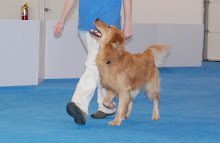
This week we had a training group discussion about building enthusiasm and having it as part of your criteria for behaviors. I definitely intentionally do a lot of this.
When Blaze was young, I was constantly trying to suppress his behaviors and enthusiasm, but I did learn to direct it in agility. This resulted in a LOT of distance, a LOT of obstacle focus and him learning to work away from me to access reinforcers.
With Luna, Griffin and most student dogs, I try to build that enthusiasm, and keep it. And direct enthusiasm appropriately rather than suppress unwanted expressions of the enthusiasm (jumping up, mouthing, barking, etc).It's hard to do with the dogs who are very wild and very shy, and especially for the novice handler.
One of the best moments in class was when we had a group of students working together. One dog staying, another walking past, and then switching roles. One student who is great at encouraging and directing behavior. The dog was very focused on the handler, they were running past the other team. If the dog did get distracted or broke his stay, the handler would quickly be calling the dog back and using a higher rate of reinforcement. The other team was also new to dogs and very uncomfortable if the young dog jumped up. THIS handler would "off off! Get down! Stop Barking!" and constantly trying to 'make' the dog work properly. Initially the handler was horrified by the other team who had great work and speed and enthusiasm. But as class went on, the wild-dog handler started to imitate the other team. She was finally able to see that the dog could still be running and working well YET be focused and working. It's not one or the other!
An area where this can be hard is with precise behaviors. In an effort to get the dog to be careful, the humans slow down, the dog then slows down and then the behavior is very slow. Some trainers say that speed is a later criteria and comes after experience and confidence. But there are many behaviors were the fast behavior is physically very different than the slower variation. If you train slow....you get slow.
An important concept for the dog to learn is speed and enthusiasm. If you get a few behaviors with speed and enthusiasm, it's easier to transition this to some others, and even all work. This can become an underlying piece of criteria.
Showing posts with label Criteria. Show all posts
Thursday, November 10, 2011
Wednesday, August 24, 2011
One Piece At a Time
It's so easy to end up working on multiple things at once. It's hard to set criteria and stick to it. Here are a few examples from this week:
1. Sit AND Take Treats Gently: I saw this more than once. Dog owners want the behavior and the dog to be gently taking the treat. If the dog is jumping up or rough, they pull the treat back and then slowly lower it while saying "eaaasy." Yes, if we give a dog a treat when he's taking it roughly we reinforce the roughness.... that said, we can't be working on our sits, downs, etc AND taking treats gently.
So? We stop and work on taking treats gently. We talk about placing the treat into the dog's mouth, rather than letting him come up to take it. We talk about how to hold the treats. We talk about other options, like tossing, dropping, putting it in a bowl, or holding the treat in a flat hand ("like feeding a horse").
Then we can go back to our sit/down/etc training....and use the "alternative feeding methods" of dropping, tossing, placing on the floor, so that the dog cannot practice improper treat taking AND we can work on the behavior/s we need.
2. Come AND Sit: Another one we see often. Dog runs to the owner! Horray, past the distractions! And then the dog is asked to Sit. The dog gets distracted at that point or doesn't comply and wanders off. Not only do we have a that sit problem.... but we didn't reinforce the brilliant recall.
We work on the running to the owner part of the recall, without an end behavior. We do consider that by placing the treats right at the human's heels or between his/her feet, the dog is extra close.
Separately, we repair the Sit and teach the dog to auto sit in front of the human. Toss a treat away. Your dog eats it and comes back. Ask for a Sit. Dog sits. You toss the treat away. Dog eats it...comes back...repeat. Soon the dog is automatically sitting on the return. Only after lots of practice in many places do we put it all together.
Dog comes. Gets a treat. Sit. Gets a treat. And we start the repetition over. When all has gone well...we start to feed less on the come and still maintain the treat for the sit.
3. Stand AND Stay AND New Reinforcer AND New Handler: This one is all my doing. Today at training, some of the others had a Really Great Idea for training Griffin's stand stay. I wasn't all for it, but it probably wouldn't hurt either. I decided to let them try it.... that way if it was a disaster, the errors would at least be associated with someone else, rather than me.
His current favorite reinforcer is "Friend with a treat bowl, running away". We've used this some on his scent work, but especially for his Drop on Recall and some heeling. The person is behind Griffin a ways. He does the behavior. I mark and send him to the person....the person runs off. Griffin catches up and is fed little treat bits until I come and drag the unwilling dog away from his best friend. He loves this because it's "Friend+Food+Chase+Lots of Food Pieces".
During his Stand training...he had a new handler, his high level food person reinforcer-thing, and it just didn't go well. He actually wouldn't even stand for the new handler. He was SO excited and worked up that he would sit and down and bounce and bark. I laughed. We quickly gave up on that.
If we were to do it...I would handle him with his running person. I would have his new handler work on quiet/less exciting reinforcers. And then we would put it all together.
Griffin was -so- happy. He's adorable when he works and his enthusiasm is very amusing. Part of it is him, part of it is that he's a golden, and part of it is our criteria for enthusiasm.
That said...we only train one part at a time... enthusiasm is one of our primary pieces.... speed. Precision is much later. That's another story.
1. Sit AND Take Treats Gently: I saw this more than once. Dog owners want the behavior and the dog to be gently taking the treat. If the dog is jumping up or rough, they pull the treat back and then slowly lower it while saying "eaaasy." Yes, if we give a dog a treat when he's taking it roughly we reinforce the roughness.... that said, we can't be working on our sits, downs, etc AND taking treats gently.
So? We stop and work on taking treats gently. We talk about placing the treat into the dog's mouth, rather than letting him come up to take it. We talk about how to hold the treats. We talk about other options, like tossing, dropping, putting it in a bowl, or holding the treat in a flat hand ("like feeding a horse").
Then we can go back to our sit/down/etc training....and use the "alternative feeding methods" of dropping, tossing, placing on the floor, so that the dog cannot practice improper treat taking AND we can work on the behavior/s we need.
2. Come AND Sit: Another one we see often. Dog runs to the owner! Horray, past the distractions! And then the dog is asked to Sit. The dog gets distracted at that point or doesn't comply and wanders off. Not only do we have a that sit problem.... but we didn't reinforce the brilliant recall.
We work on the running to the owner part of the recall, without an end behavior. We do consider that by placing the treats right at the human's heels or between his/her feet, the dog is extra close.
Separately, we repair the Sit and teach the dog to auto sit in front of the human. Toss a treat away. Your dog eats it and comes back. Ask for a Sit. Dog sits. You toss the treat away. Dog eats it...comes back...repeat. Soon the dog is automatically sitting on the return. Only after lots of practice in many places do we put it all together.
Dog comes. Gets a treat. Sit. Gets a treat. And we start the repetition over. When all has gone well...we start to feed less on the come and still maintain the treat for the sit.
3. Stand AND Stay AND New Reinforcer AND New Handler: This one is all my doing. Today at training, some of the others had a Really Great Idea for training Griffin's stand stay. I wasn't all for it, but it probably wouldn't hurt either. I decided to let them try it.... that way if it was a disaster, the errors would at least be associated with someone else, rather than me.
His current favorite reinforcer is "Friend with a treat bowl, running away". We've used this some on his scent work, but especially for his Drop on Recall and some heeling. The person is behind Griffin a ways. He does the behavior. I mark and send him to the person....the person runs off. Griffin catches up and is fed little treat bits until I come and drag the unwilling dog away from his best friend. He loves this because it's "Friend+Food+Chase+Lots of Food Pieces".
During his Stand training...he had a new handler, his high level food person reinforcer-thing, and it just didn't go well. He actually wouldn't even stand for the new handler. He was SO excited and worked up that he would sit and down and bounce and bark. I laughed. We quickly gave up on that.
If we were to do it...I would handle him with his running person. I would have his new handler work on quiet/less exciting reinforcers. And then we would put it all together.
Griffin was -so- happy. He's adorable when he works and his enthusiasm is very amusing. Part of it is him, part of it is that he's a golden, and part of it is our criteria for enthusiasm.
That said...we only train one part at a time... enthusiasm is one of our primary pieces.... speed. Precision is much later. That's another story.
Labels:
Criteria,
Griffin,
Reinforcer,
Training
Wednesday, March 30, 2011
Maintain Criteria
This is something that comes up regularly in the higher level classes or with the more advanced students.
There's a point in training where sometimes we want to reward every response and every bit of effort. Error-less learning can be a good thing.... but if we're having to talk about maintaining criteria.... there are errors that are being reinforced!
Training a dog can be hard, because we do have to adjust our criteria to the environment. It's not quite like cooking where you do one step and then go to the next. We have to be aware of our surroundings and our learner's state and adjust accordingly.
But we do need to remember to maintain criteria...at almost any stage there are things that we do not need to be reinforcing any longer and it's important to keep the end goal in mind and it's important that we are constantly working towards that goal.
Sunday, October 3, 2010
Adjusting Criteria for the Humans
Sometimes in class we adjust criteria for the dogs, but more often it's for the people.
In a recent class, we had a dog making amazing progress. He needed more challenge, there was no reason his part to stay at the current level. But his owner was very stressed, still had some not so stellar training mechanics, and if we made things harder it could ultimately backfire.
So, as we were working with reactive dogs, we changed nothing that team was doing. We had another team get closer. And closer. And then we had the first team move out 3 feet (...we have a huge training space!). And everything was great.
I could have done a training exercise where the team was changing path. Or moving in a different way. Or doing about turns. Or doing long pauses. Or arcing. And it could have gone well, but it also could have been more stress than was needed.
Recently I've been looking at how I might be holding back my dogs. I've been a bit more diligent about video taping (is it called that if we don't use tape?) and looking at the video, and making adjustments. I probably should set aside some time to work on my skills away from my dogs. I've been using the shelter dogs to practice some things I need for work, as well as a few placement-of-reinforcer variations that will impact how I work with my dogs too. It almost feels like I'm flailing, I've never been out of real training class for so long, my dogs and I need it! I've checked with eight facilities, some agility, some everything, some pet training, and nothing is fitting in with our schedule. Maybe its time I work less.
In a recent class, we had a dog making amazing progress. He needed more challenge, there was no reason his part to stay at the current level. But his owner was very stressed, still had some not so stellar training mechanics, and if we made things harder it could ultimately backfire.
So, as we were working with reactive dogs, we changed nothing that team was doing. We had another team get closer. And closer. And then we had the first team move out 3 feet (...we have a huge training space!). And everything was great.
I could have done a training exercise where the team was changing path. Or moving in a different way. Or doing about turns. Or doing long pauses. Or arcing. And it could have gone well, but it also could have been more stress than was needed.
Recently I've been looking at how I might be holding back my dogs. I've been a bit more diligent about video taping (is it called that if we don't use tape?) and looking at the video, and making adjustments. I probably should set aside some time to work on my skills away from my dogs. I've been using the shelter dogs to practice some things I need for work, as well as a few placement-of-reinforcer variations that will impact how I work with my dogs too. It almost feels like I'm flailing, I've never been out of real training class for so long, my dogs and I need it! I've checked with eight facilities, some agility, some everything, some pet training, and nothing is fitting in with our schedule. Maybe its time I work less.
Subscribe to:
Posts (Atom)