- Use great treats.
- Work on one thing at a time.
- Many short sessions a day are better than one or two long sessions.
- Any sessions are better than no sessions.
- Training sessions can last 15 seconds or a few minutes
- After a few minutes, take a break for petting or play. If you want to keep training you can go back to the same behavior or something different.
- Start each session at a "point of success"
When I started training Blaze, we would practice everything he knew, sometimes every day. Now, my training sessions look very different. Good training is not running through everything once or twice, that doesn't give the repetition that a dog needs to learn. However, there are times to do everything just a few times. 1) For some people, after a bad day it can make you feel better to see all the amazing things your dog can do. 2) You can show off how smart your dog is to friends or family.
So what does a purposeful training session look like? You pick one aspect to work on. You work for no more than 3-4 minutes. You take a break with your dog and evaluate your progress. This will help you get from point A to point B in your training and make the most of your limited time.
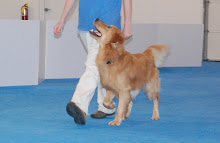
Here's an example from training Griffin to stand.
What we have: He could stand readily on a visual cue. He does not know a word for standing.
Session 1: Warm him up by reinforcing a few non-cued (offered) stands. Use a treat to get him back into the Down (because we do not want to work on the down right now). Add the word right as he stands.
What happened: It went fast and by 4-5 repetitions he was responding to the word!
Session 2: Warm him up with a few cued repetitions and then start to vary my position. Rather than being in front of him, I would stand a step to the side, the other side, back, hands up, holding something.
What happened: It went really well unless I was 3 steps away. Then he would Sit rather than stand. I only did two repetitions and moved on to other types of challenges.
Session 3: Warm him up with a few repetitions right in front of me. Every few repetitions I would move back by 1/2 a step (rather than the full steps I used in the previous session).
What happened: We worked up to 4 steps away.
 |
| Griffin says "Leaping is more fun than standing." |
Each session lasted 60-90 seconds. We made unusually fast progress with this behavior. It was helped because he already knew how to stand (on a different cue, a hand signal) and because he knew how to stand stay.