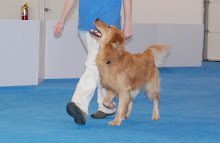
First off... my goal was to have Griffin working well around other dogs. We achieved that goal! It was a small group (about 6 dog slots, a few people switched out dogs). Griffin worked well and even sat still with me in the 6'x 12' "sitting" area.
The content was good, the participants had a good time. I didn't know any of them but I was surprised that they weren't more comfortable teaching tricks. I always think it's fairly straightforward to at least come up with rudimentary steps...but then realize that's not the case.
Shaping was the real topic of the workshop, the presenter told us... but it got very interesting from that point. There are a bazillion variations of 'clicker training' but it was the first time I heard someone prefer to use clicker training only for stationary behaviors and not for moving behaviors. I'll have to think this one over, the examples given to explain this seemed to be more about criteria and placement of reinforcer rather than clicker use being a poor choice for the behavior.
Most of the behaviors we worked on confused me. A lot. And not because it was poorly taught, it was quite well done!
1) Nose Touching: Griff knows this well, we quickly went to duration to remind him to sticky touch. Great. And then we were to add distance. I was trying for distance on the ground. So each rep, I held the plate a bit lower. And we soon got to the ground. (In July, prior to the Lyme disaster we worked on this as a possible fix for our teeter performance). Soon Griffin was touching it on the ground, sticking until released. And we started adding distance. It was so great! And then he retrieved it. I didn't know what to do, taking it is part of the retrieve chain and could be a little reinforcing even if I did not reinforce with food. I could not leave him there, he has been taught a HUGE duration for holding items still. So I took it. On the floor. He picked it up. We did several more in hand, lowering it to the ground. But he went back to retrieves.
So... What was my problem? How should I respond? I had a few options:
- Give him a few more tries, eventually he might touch again.
- In hand, and MANY reps before lowering to the ground.
- Reinforce as he moved towards the plate
- Get retrieve on cue and good stimulus control
- Put plate touch on cue.
- After the two above, treat it as a discrimination exercise.
And really, fro training tests, one of the hardest things I've ever had to teach was a discrimination with one prop where we had to do two behaviors. Most people in that group chose a nose touch and foot touch. I cheated somewhat and did a nose touch and a hip touch. VERY different. And after that training group..I vowed to never do foot/nose on the same target. It was a horribly evil exercise.
So...we have a big discrimination task with the target...nose and mouth.
My solution? I did more in hand and then the session was over.
But long term? What will be the best way to get a good discrimination here? Should I use a visual cue? verbal cue? or use specific props that indicate x/y/z behavior? Do I want a dog that really understands the verbal cues? Or do I want a dog with super strong responses that are VERY clear. You ONLY do x behavior with THIS prop. Or can I have both? But how much work is it to get both?
2) Behavior two: waving a foot, on visual cue, at a distance.
Griffin has a foot wave on verbal cue only (taught with capturing). It's really cute. Switching to a visual cue is easy. New cue, old cue, behavior, click, treat. I was feeding in position to keep the stationary sit.
And sometimes, he would do well. I got smart and also fed him for NOT waving if I was NOT asking. And then I'd ask and he did well. But now and then... he would not wave. He would look at me and say "I am sitting. You can't fool me!"
There's a proofing exercise that seems to get a lot of attention for a while and then I hear nothing about it for months/years. Take a behavior your dog knows on cue well. You list a bunch of nonsense words. And at some point, give the cue, and reinforce that response. Your dog is learning to only respond to the actual cue, and is proofed against other things. I don't do a lot of this, but all my dogs have had it at some point. Not a lot. But a little.
And this whole scenario at the workshop brought back thoughts from a Friday training group meeting a few months ago. What if the dogs see this cue transfer as a proofing exercise? Is it the best way to change a cue? Why is it such a common recommendation?
Did I change what I was doing? No. I kept working and used the trusty new cue-old cue pattern. But what if I could be more efficient?
Part 2 later... over-riding/ultimate/? behaviors, my dog not in peak condition, and do I have a "helping addiction"?
 And I do need new trick pictures to use. I really like this one though.