Sunday, February 14, 2010

Competition Obedience, Pet Training, Behavior Challenges


A phone call today prompted me to think about how I discuss competition behaviors, basic manners, and behavior-problem-solving.

Someone wanted to be involved in a competition program. Because the dog lacked basic manners. And the family was concerned over some over-arousal, some possibly normal puppy mouthing, and some resource guarding.

Basic manners and competition behaviors definitely improve the human-animal bond. The training can improve the communication between a dog and family. But very rarely does this solve behavior challenges families are experiencing.

Fear is a large part of the challenges I see. We need to separately address this, not pushing the dog past the point of being afraid, and teach him ways to be more comfortable with the world. The activities we do are often very different from basic manners training. We do a lot of classical conditioning (...in this case, pairing super special food with a very very tiny version of the scary thing, like dropping a spoon 5" onto carpet, rather than a pot onto the hard kitchen floor). We do other training too, teaching dogs to offer behaviors and respond to cues.

Basic training involves teaching dogs to respond to the cues we use in day to day life. Walk on a nice leash, come when called in the house or yard, drop items on cue. Sit or lie down when asked, wait on a mat while dinner is prepared, greet visitors politely.

And competition training...is all the super precise behaviors we use for obedience, rally, agility, or other activities. We want the dog respond to the first cue, immediately, and as quickly as possible. We have a precise way we want the behaviors performed. We want the same exact response, time and time again.

Most people want the manners before competition training, thinking the dog needs to know that before you can have competition behaviors. I -strongly- diasgree with one exception... and that is the family has to be able to live with the dog, and so all the cues that allow the family to co-exist are necessary. If the dog is not with the family, he won't be learning anything.

But basic manner behaviors don't need to be super precise. Latency (...time from cue to start of response) doesn't have to be next-to-zero. A slightly different response every time is a big deal. And really, if you have to repeat a cue on occasion, no big deal. And when you go to train competition behaviors...there is additional training to teach the dog he should respond right away, respond quickly, be super attentive and be aware of tiny differences.

So if you intend to be involved in competition activities...find a competition class. Take it at the same time as a manners class. Or let your instructor know, so s/he can help you create precise and immediate responses.

And here's where I would say something clever about the three groups of training. But....in summary...they're different, have their uses, and are necessary. But pet training doesn't make competition behaviors easier!

Monday, February 8, 2010

Training and Reading

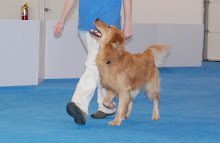
Luna got to help out testing a new class at PosiDog last week. The class is going to be brilliant, but Luna, was not. I'll have to be taking my own advice: ALL food from food toys and training, and daily off-property leash walks. We've yet to do the walks, with being snowed in and it being too cold tonight for her to wait in the car while I teach... but...it's on our agenda.

While you are snowed in this week..parts of a clicker agility book are available:

http://agilitynerd.com/blog/agility/publications/ClickAndPlayAgility.html

Have fun,

Thursday, February 4, 2010

Explaining Teaching

First off...to further promote:
http://goclickchallenge.wordpress.com/

Read/watch and enjoy. Join in and share your training too. Laugh at my attempts to quickly train varied behaviors. Be amazed by the successes of others!

**********************

Now to the technical part of today. I was recently asked about my teaching process. And I felt like I gave a really incomplete answer. Yesterday however, while I was listening to an explanation of the "Delta Rule" for learning, I was able to use parts of that for how to explain my thought process when teaching.

http://en.wikipedia.org/wiki/Delta_rule

For everything we do, I have a picture of the "Ideal response". I tend to ask students to "show me where you are at". I compare that to the ideal, and note the differences. From there, I look at those differences and pick which one is likely to be best to first modify (Remember, for "Good Training" we modify only one thing at a time!). We do a few repetitions together and I give the student a couple of minutes to work at that level before we make additional modifications until we are at the "Ideal Response."

The differences can be what the dog is doing or what the handler is doing. Maybe I want the handler to keep hands at side ("Hands at side. After the click finishes, move your hands." Maybe I want the dog to sit right away ("If he pauses...move away and then try again.") Maybe I want the treat to be delivered under the dog's chin "Feed head straight, chin tucked [yes...that's two...shh]." Maybe I want one cue only "Sit once, then silence." There are four things that all need to be changing to improve the behavior of "Sit." If I gave all four to a student, s/he (and I!) would be overwhelmed.

I look at the priorities of each one to decide which is the most important right away. The order can depend on the dog/handler students, their abilities, and goals. For an average team... here are my thoughts:

Hands at side: This is important regardless of competition goals or pet training goals. This also tells me I should have caught this earlier too. This will impact the handler on all behaviors.
Latency: We want the dog sitting right away. This is important but may be fixed as we address these other issues. If he's not attentive until he hears the owner's hand in the treat bag...fixing the first issue may fix this.
Feeding Position: This is important with a bouncy young dog, less so with a more stationary dog.
One cue: Again, something that will impact the handler on everything. However, if the dog has lower latency [is responding right away], the owner may not feel the need to be cueing twice.

Going over this list... half the points point to fixing "hands at side" first. In TAG Teach language this could well be a "Value Added Tag Point." But fixing one thing, we are fixing half of all our problems! Addressing this first will be key.

I will explain and demonstrate about 5 times. Then let the handler take a few turns with me observing. I'll then work my way around to other students, and when I get back we'll work on our next piece, "Placement and presentation of reinforcer."

Now that was boring wasn't it.

Sunday, January 31, 2010

Teaching: Focus Points

I've been prompted to think a lot this week about my teaching, thanks to a student and friend.

All instructors tend to have a few focus points they are stuck on. I know for the last two months mine has been "Placement of reinforcer" and this last month I have added in "Presentation." This has greatly helped my training with my own dogs, as well as the training my students in all my classes/lessons. But...I need to think about all the other important things too!

Some focus points that I will need to focus on in different weeks:
Speed and latency, Shaping skills, mechanical skills, fluency, toys as reinforcer, real world applications, challenges...

On other notes, Griff and I, and a two-legged student, visited a 4H/FFA club in another county today to give a workshop. Griffin and I were the students while the 'real' students had a chance to judge. He was adorable and his heeling was beautiful! He did two whole patterns, his only errors were a stop and sniff when our 'judge' directed us over a hose and into a wall, and when we were 'left turned' right into a bucket...Griffin went on the other side and immediately resumed heel.

Some of the things the students learned in this three hour lesson today:
-Proper obedience handling for heeling: via tag-teach
-Clicker introduction and mechanical skills
-Targeting: taught by my assistant for the day
-Go-around an object
-Call fronts

Time goes fast and I really could teach more long lessons. The time went fast and I can't wait for my next time with this group!

This is going to be a great week with agility class starting at PosiDog!

Saturday, January 23, 2010

Speed:

I'm not so great about sharing videos and pictures that include me. Next practice I'll get a short one. Short is a start (...lower my criteria for myself, right?!).

Recent talks with training buddies, students, and professionals in varied fields is making me stop thinking about speed as something we add to behaviors after they're started, offered, and close to perfect. In so many settings, and especially for competition behaviors, it needs to be one of the earliest, if not the earliest priority.

Performing with speed can put a different emotional response to a behavior. It can make the striding and so the actual performance of a behavior different. It can make faults more likely or less likely to happen.

I need to constantly be reminded with my own dogs to keep this a priority. But I'm doing pretty well with student dogs. And even my non-sports students hear some of this when we talk about recalls. The slow puppies? Practice recalls at the time of day when they're most likely to be wild. We want to practice with speed!

A recent example is Griffin's contact behavior. We did about 30 reps with the aframe at Posidog last week. He hit every contact (1 was close to the top, one close to the bottom.). He was VERY consistent with his speed. But he felt slow. Reviewing the video, his performance was about 1.5 seconds long. I compared it to a video of Luna last year (...or the year before?) where she was moving almost as fast as she could, really trying, and looking fast. She was 2.5. I've been puzzled about that. I don't know that Luna can get faster...but Griffin sure can!

Some parts of my plan for increased speed:
- Use a thrown toy as a reinforcer rather than thrown food.
- Recall him over, or have his favorite people recall him over.
- Improve speed on all his behaviors.
- Reinforce speed in play
- Play and run with him more.

Off to think about speed....

Sunday, January 17, 2010

Training Troubleshooting

I put these on our camp blog, but thought it deserved a mention here. Horray for copy and paste!


When you're having a problem with training...look at these pieces:

1) What is your rate of reinforcement. How many times/minute are you click/treating. The higher this number per minute, the better. An exception would be behaviors that take a long time (...retrieve) or duration behaviors (stays or heeling).
2) What is the placement of reinforcer? Where exactly are you putting your reinforcer? If you have a stay exercise, you almost always want to feed the dog in position, with his chin tucked a little. If you are doing heeling with a slow dog, toss the treat ahead. If you are heeling with an excited dog, feed at nose level, right along your leg. If you are doing fronts...feed right where your dog's head should be: Straight and close to you.
3) Think about how you present the reinforcer. Do you move your hand to his mouth? Do you have him move to get it? Do you toss the reinforcer?

Thursday, January 14, 2010

Preparing for Classes

I'm currently finishing the last preparations on my curriculum for my agility class due to start at PosiDog soon. Instructors do put care into these projects!

It's a challenge to go through what I think are all the important foundation skills, balance them out so everyone gets enough practice on everything, and to keep it fun. There's not really a part of dog training that shouldn't be fun... but when you sign up for an agility class you're probably wanting to start playing with the equipment.

But there's a lot more to agility than just the equipment. Most of the game is about what's going on in between the obstacles. If our dogs are good at learning, they will learn the obstacles faster. If your dog already knows a lot of behaviors, he will learn this game faster. If we practice on speed activities, your dog will be faster in agility. If your dog knows about how to move his body, especially in relation to objects and obstacles, he will learn faster.

The great thing about foundation classes like this, is that you can do almost all of your homework in the house and that you really don't need any equipment.